
Introduction
A construction equipment OEM approved a batch of hydraulic pump housings from a new casting supplier based on visual inspection and a price 28% below their existing source. Within six months, 34% of units failed in the field from internal porosity that pressure testing would have caught before assembly. The recall and warranty replacement cost was 11 times the amount saved on the original order.
Here’s the data point that should concern every hydraulic system buyer: industry research shows that over 60% of hydraulic pump failures originate from casting defects or material selection errors—not from seal wear, contamination, or operational misuse. Pump housings, end covers, manifolds, and port blocks operate under continuous cyclic pressure loads that expose every void, thin wall, and stress concentration the casting process creates. This guide covers material selection, casting process trade-offs, critical failure modes, and the quality verification steps that separate reliable pump castings from ones that fail prematurely.
Hydraulic Pump Casting Basics
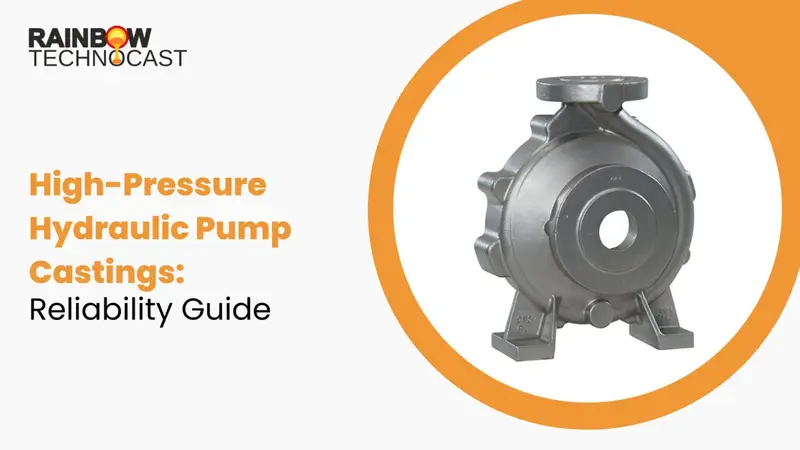
Hydraulic pump castings form the pressure-containing structure of every pump assembly. They house rotating components, route fluid through inlet and outlet passages, and seal system pressure at every interface. The typical cast components include:
- Pump housings and bodies
- Front and rear end covers
- Valve plates and port blocks
- Manifolds and distribution blocks
- Bearing carriers and mounting flanges
These parts operate under pressures from 200 bar in standard industrial systems to 700 bar in high-performance mobile hydraulics. Every casting must contain pressure, resist fatigue over millions of cycles, and maintain dimensional stability at operating temperatures that reach 80-100°C continuously.
Material Selection
Material choice determines pressure capacity, fatigue life, and corrosion resistance—the three properties that define casting reliability.
Cast Iron
Grey cast iron (ASTM A48) provides excellent machinability, vibration damping, and cost efficiency for gear and vane pump housings operating below 250 bar. Its graphite microstructure absorbs vibration well but creates crack initiation points under impact or shock loading. It’s the right choice for stable industrial duty at moderate pressures, not for mobile equipment subject to sudden load spikes.
Ductile Iron
Ductile iron (ASTM A536) replaces the flake graphite of grey iron with nodular graphite, delivering tensile strength of 414-552 MPa versus grey iron’s 170-275 MPa. This makes it the dominant material for high-pressure gear pump and piston pump housings. It handles pressure spikes and cyclic loading that grey iron absorbs poorly, and it costs 15-20% more—a difference that erases quickly against grey iron’s shorter service life in demanding duty cycles.
Steel and Alloy Steel
Carbon and alloy steel investment castings handle extreme pressures exceeding 500 bar and cyclic loads that fatigue iron alloys. ASTM A216 WCB carbon steel suits most high-pressure industrial hydraulic service. Chrome-moly alloys (4130, 4140) add fatigue resistance for mobile and shock-loaded applications. Heat treatment after casting—normalizing, quenching, and tempering—is mandatory to achieve full mechanical properties.
Stainless Steel
316 stainless steel pump castings suit hydraulic systems handling water-glycol fluids, fire-resistant hydraulic fluids, or seawater-based systems. Standard mineral oil hydraulic systems don’t require stainless steel, but offshore, food processing, and marine hydraulic power units do. Stainless steel costs 3-4 times more than ductile iron—specify it only when fluid chemistry or environmental exposure makes it necessary.
Casting Processes
Process selection determines defect risk, dimensional accuracy, and production economics.
Sand Casting
Sand casting suits large pump housings (above 5 kg) where complex internal passages require core assembly and tight tooling costs aren’t justified by volume. Surface finish runs 125-500 RMS, requiring substantial machining on all sealing faces and bearing bores. Internal porosity risk is higher than investment casting, making NDT inspection critical on every part rather than batch sampling.
Investment Casting
Investment casting delivers 63-125 RMS surface finish and ±0.005 inch tolerances on complex geometries. For pump components with intricate internal passages, multiple port connections, and tight sealing surface requirements, investment casting eliminates 60-70% of the machining that sand castings require. The process suits components from 0.1 kg to 15 kg—covering most hydraulic pump castings outside the largest industrial units.
Failure Modes
Understanding how pump castings fail guides both design decisions and inspection priorities.
Porosity and Shrinkage
Internal gas porosity and shrinkage voids reduce effective wall thickness and create stress concentration points that crack under cyclic pressure. A 2mm void in a 10mm wall reduces local fatigue strength by 40-60%. Radiographic inspection detects these defects before assembly; visual and dimensional inspection misses them entirely.
Fatigue Cracking
Hydraulic pumps cycle from zero to full pressure thousands of times daily. Stress concentrations at sharp internal corners, thin sections near ports, and abrupt wall transitions initiate fatigue cracks that propagate to catastrophic failure. Castings with generous fillet radii at all internal transitions and uniform wall thickness across pressure-loaded sections resist fatigue significantly better than designs optimized purely for minimum weight.
Cavitation and Erosion
Cavitation forms when fluid pressure drops below vapor pressure at inlet restrictions, creating vapor bubbles that implode against internal casting surfaces. The resulting micro-erosion pits the casting wall and removes material progressively. Smooth, well-proportioned inlet passages with adequate cross-sectional area prevent the pressure drops that trigger cavitation. Rough surface finish from sand casting accelerates the process.
Quality Control and Testing
The uncomfortable reality: castings with paperwork but without physical testing fail as reliably as castings with no documentation at all.
Material Verification
Spectrometric analysis confirms alloy chemistry on every heat before pouring. Mill test certificates document composition results and form the traceability chain from melt to finished part. Foundries that can’t provide heat-specific documentation are guessing at their own material properties.
Non-Destructive Testing
Effective NDT for high-pressure hydraulic pump castings includes:
- Radiographic testing (RT): Detects internal porosity, shrinkage, and inclusions
- Ultrasonic testing (UT): Measures wall thickness and detects planar defects
- Dye penetrant inspection (DPI): Finds surface-breaking cracks and seams
- Magnetic particle inspection (MPI): Detects near-surface defects in ferrous castings
Batch sampling is inadequate for safety-critical hydraulic components. High-pressure pump castings warrant 100% RT on the first article runs and meaningful sample rates on production batches.
Pressure and Leak Testing
Proof pressure testing at 1.5 times maximum working pressure confirms structural integrity and identifies leaking porosity before assembly. For a pump rated to 350 bar, proof testing to 525 bar with a 30-minute hold period catches marginal castings that would fail early in service.
Reliability by Application
Different duty cycles stress pump castings in distinct ways.
Mobile hydraulics (excavators, cranes, agricultural):
- Prioritize ductile iron or alloy steel for shock resistance
- Specify minimum wall thickness 20% above pressure calculation
- Mandate 100% dimensional inspection on sealing faces
Industrial power units (presses, machine tools):
- Grey iron or ductile iron handles stable continuous duty
- Investment casting improves port geometry consistency
- Pressure testing every unit before shipping
Construction and mining:
- Alloy steel castings with heat treatment for extreme cyclic loading
- Thicker walls at high-stress zones around port intersections
- Full radiographic inspection for critical components
Conclusion
Match casting material and process to your actual hydraulic duty cycle. Specify NDT requirements before ordering, not after failures appear. Proof test every high-pressure housing before installation.
Request material certifications and NDT capability documentation from your current casting supplier this week.
Rainbow Technocast manufactures precision investment cast hydraulic pump components—housings, end covers, valve plates, and manifolds—in ductile iron, carbon steel, alloy steel, and stainless steel for industrial, mobile, and specialist hydraulic applications. Our fully integrated foundry delivers dimensional accuracy within ±0.005 inches, 100% spectrometric material verification, and radiographic inspection capability that eliminates the internal defects responsible for most high-pressure pump casting failures. Every casting ships with full material traceability documentation and proof pressure test certification.
Visit rainbowtechnocast.thinkingstation.com/ to request technical specifications, NDT capability data, and quotations for your hydraulic pump casting requirements. Let’s engineer reliability into your hydraulic systems.