
Introduction
Here’s a problem that most procurement managers don’t catch until it’s too late: two ball valves with identical pressure ratings and the same end connections — one lasts a decade in a refinery line, the other fails inside 18 months. The difference, almost always, comes down to how the body was cast and what material grade was actually used versus what the label claims.
Ball valve casting is not a commodity process. The casting method determines structural integrity; the material grade determines chemical resistance and pressure capacity; and the quality of machining post-casting determines leak-tightness. Get any one of these wrong and no certification stamp fixes it.
This guide covers what ball valve casting actually involves — the three main casting processes, the material grades that matter by application, the full production sequence from mold to test, and how to tell a well-cast valve from one that cuts corners at the foundry stage.
What Ball Valve Casting Is
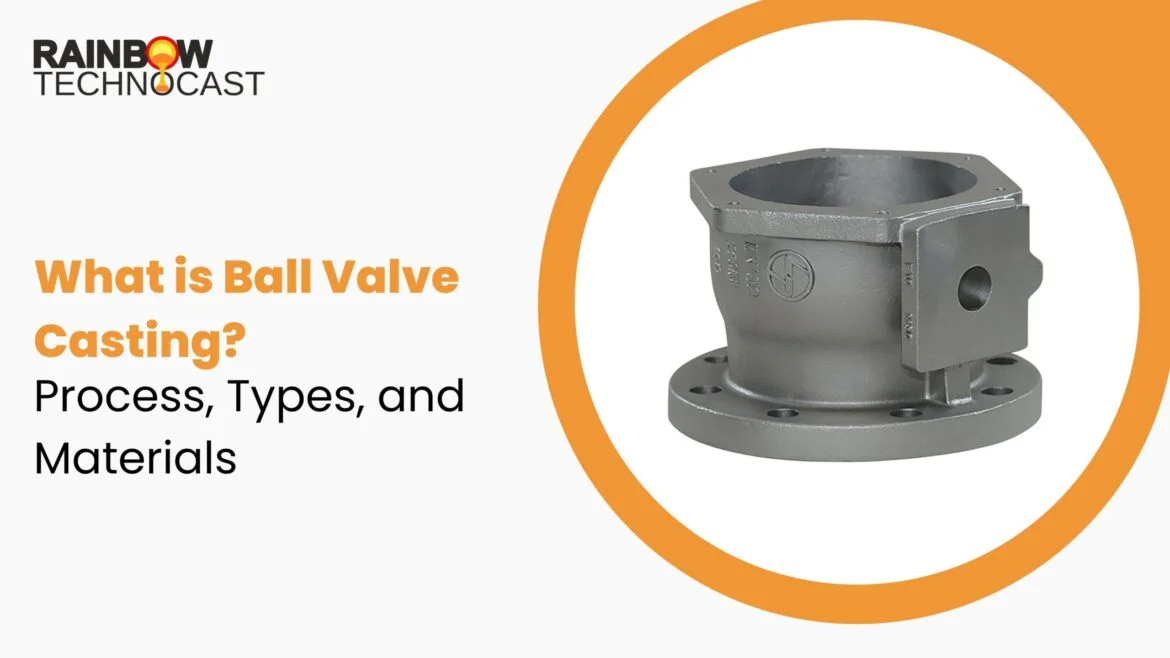
Casting is the process of pouring molten metal into a shaped mold and allowing it to solidify into a near-net form. For ball valves, this produces the body, end caps, and sometimes the ball itself — the parts that contain pressure and define the valve’s structural performance.
The case for casting over machining from bar stock: it handles complex geometries, supports a wide range of material grades, and scales efficiently for production volumes. A cast body can accommodate the curved internal ports, thick flanged ends, and varying wall sections that a forged or machined body can’t achieve as cost-effectively.
A counterintuitive reality: most ball valve bodies sold as “premium” in export markets originate from foundries in India and China. The casting quality is the variable — not the country of origin.
Casting Processes
Sand Casting
Sand casting packs a sand mixture around a pattern, removes the pattern to create a cavity, and pours molten metal in. It handles large valves (DN200 and above), tolerates complex internal geometries, and works across most metal grades.
- Best for: large-bore, low-to-moderate pressure applications
- Typical materials: carbon steel, cast iron, ductile iron
- Limitation: surface finish is rougher; requires more machining post-cast
Investment Casting (Lost Wax)
A wax pattern is coated in ceramic slurry, the wax melted out, and metal poured into the ceramic shell. This gives tight dimensional tolerances and a smooth surface — critical for seats, sealing faces, and close-clearance components.
- Best for: precision valves in stainless steel and high-alloy grades
- Typical materials: CF8, CF8M (equivalent to 304/316), duplex, super duplex, Inconel
- Advantage: near-net shape reduces CNC machining time and material waste
Lost Foam Casting
A foam pattern is embedded directly in sand and vaporizes when metal is poured. It produces complex shapes in a single casting without a parting line — useful for internal passages that are difficult to core.
- Best for: iron-grade valves, complex internal geometries
- Limitation: less commonly used for high-pressure stainless applications
Common Casting Materials
The material grade carries more performance responsibility than the casting method. Here’s how the main grades stack up:
| Material | ASTM Grade | Best Application |
| Carbon steel | A216 WCB | General service: oil, gas, water, steam |
| Stainless steel 304 | CF8 | Mild corrosives, food, water |
| Stainless steel 316 | CF8M | Chlorides, chemicals, marine service |
| Duplex SS | CD4MCu | High-chloride, offshore, seawater |
| Super duplex SS | CE8MN / CD3MWCuN | Severe corrosion + high pressure |
| Cast iron | ASTM A126 Class B | Low-pressure water and HVAC |
| Ductile iron | ASTM A395 | Higher-strength water/wastewater |
| Nickel alloys | CW6MC (Alloy C-276) | Concentrated acids, extreme chemical service |
The Casting Process Step by Step
- Pattern and mold preparation — create the pattern (sand or wax), form the mold cavity, install cores for internal passages
- Melting — charge the furnace with base metal and alloy additions; verify chemistry by spectrometer before pouring
- Pouring — fill the mold at the correct temperature; improper temperature causes shrinkage defects and cold shuts
- Cooling and solidification — controlled cooling prevents internal cracking (hot tears) and shrinkage voids
- Shakeout and cleaning — break away mold material, cut off gates and risers, shot-blast the casting surface
- Heat treatment — solution annealing for stainless grades normalizes the microstructure and restores corrosion resistance after casting heat
Machining and Finishing
A casting is not a valve. The bore, seat pockets, stem hole, and flange faces all require CNC machining to dimensional tolerances that the casting process alone cannot achieve.
Key machining operations:
- Bore machining to final flow diameter and surface finish
- Seat face turning for metal-to-metal or soft seat installation
- Stem hole drilling and threading
- Flange face machining to ASME B16.5 raised-face or flat-face finish
Surface treatments applied post-machining:
- Electroless nickel plating (ENP) — corrosion and wear resistance on carbon steel
- Chrome plating — hardness on the ball surface
- Tungsten carbide overlay — severe erosion resistance for slurry and abrasive service
Testing and Quality Control
Every cast ball valve should pass through this sequence before it leaves the facility:
- Shell (hydrostatic) test — body integrity at 1.5x rated pressure
- Seat leakage test — zero visible leakage at rated pressure, per API 598 or BS 6755
- Torque test — confirms the actuator or handwheel can operate the valve across full pressure
- Dimensional inspection — face-to-face, bore diameter, and flange drilling against ASME B16.10 and B16.34
- Non-destructive testing (NDT) — magnetic particle (MT) or dye penetrant (PT) for surface cracks; ultrasonic (UT) for subsurface defects in critical-service castings
A mill test report (MTR) should accompany every batch — it documents the actual chemical composition and mechanical properties of the heat used, not generic grade averages.
Cast vs. Forged Ball Valves
This is a genuine design decision, not a quality ranking. Cast valves are not inferior to forged — they serve different applications.
| Property | Cast | Forged |
| Design flexibility | High — complex geometries | Lower — limited to simpler shapes |
| Strength at small bore | Moderate | Higher grain density, better for ≤DN50 |
| Large bore availability | Practical and cost-effective | Expensive and heavy |
| Material range | Very wide | Limited by forging die availability |
| Typical application | DN50 and above, process plants | Small bore, high-pressure, critical service |
A common procurement error: specifying forged valves for large-bore, low-pressure water lines where casting is entirely adequate — and paying a 40–60% premium for no engineering benefit.
FAQs
What does WCB mean on a ball valve casting?
WCB is an ASTM A216 grade designation for cast carbon steel — it stands for Wrought Carbon Steel Grade B. It covers the most widely used material in general-purpose industrial valve bodies, rated for temperatures from -29°C to 425°C. When you see “A216 WCB” on a test certificate, it confirms the carbon and alloy content meets that standard.
Is investment casting better than sand casting for ball valves?
Not categorically — it depends on size and application. Investment casting delivers tighter tolerances and smoother surfaces, making it preferred for stainless and high-alloy small-to-medium bore valves. Sand casting is more practical for large-bore valves and iron grades where surface finish requirements are less critical. The right process follows the application, not a hierarchy.
How do I verify a casting hasn’t been substituted with a lower grade?
Request the mill test report (MTR) and cross-check the heat number stamped on the valve body against the MTR. The MTR must show chemical analysis results, mechanical test results, and the heat number. If a supplier can’t produce an MTR tied to a specific heat, treat the material grade as unverified.
Can casting defects be repaired?
Minor surface defects in non-pressure areas can be repaired by approved welding procedures under standards like ASME Section IX. However, pressure-retaining areas with cracks or significant porosity typically mean the casting is rejected — not repaired. Always ask whether a supplier’s defect rejection rate and repair policy are documented.
Conclusion
The quality of a ball valve starts at the casting stage — before machining, before seat installation, before any test certificate gets printed. Specifying the right casting process and the correct material grade are the two decisions that determine how a valve performs across its service life.
If you’re sourcing ball valves for a critical application, get the MTR, verify the casting standard, and confirm the testing sequence before you commit to a supplier.
Rainbow Technocast produces cast ball valve bodies and finished valves in WCB, CF8, CF8M, duplex, and other alloy grades — through sand and investment casting processes, with in-house CNC machining, heat treatment, and pressure testing. Every batch ships with full documentation: MTRs, dimensional reports, and hydrostatic test certificates.
Specify your grade, pressure class, and end connection — get a quote at rainbowtechnocast.thinkingstation.com/.