
Shutdowns on Oil Rigs can cost up to £2,000,000 per day, and valve repair and maintenance can cost up to £30,000 a time. Yet most engineers still spec butterfly valves like commodity purchases—focusing on initial cost while ignoring the operational mathematics that determine whether a valve becomes a profit center or a liability generator.
The actuated butterfly valve market tells a different story. The global butterfly valve market was valued at USD 11.3 billion in 2024 and is expected to reach USD 18.4 billion by 2034, growing at a CAGR of 5%, with the electric-actuated butterfly valve market size valued at USD 2,909.8 million in 2024 and estimated to grow at a CAGR of 5%, driving the premium end. This growth isn’t just expansion—it’s operators realizing that reliability engineering beats reactive maintenance every time.
Actuated Butterfly Valves: When Integration Beats Addition
Most valve failures aren’t valve failures—they’re system integration failures disguised as component problems.
Traditional approaches bolt an actuator onto a valve and call it automated. Smart engineering recognizes that actuated butterfly valves function as unified control systems where every component influences overall performance.
Actuation Architecture That Actually Works
- Pneumatic Systems: Deliver fast response and fail-safe reliability for on/off applications. The sweet spot for cycle-heavy services is where speed trumps precision, particularly in emergency shutdown sequences.
- Electric Actuation: Provides precise positioning and diagnostic feedback for modulating control. Essential where the high-performance butterfly valve market is expanding from an estimated $7,232.1 million in 2024 to a colossal $15,758.7 million by 2034, fueled by a CAGR of 8.1% because precision control translates directly to operational efficiency.
Control Integration Logic
- On/off applications demand binary reliability—position confirmation within milliseconds, not seconds
- Modulating control requires positioner feedback loops that eliminate hunting and overshoot
- Fail-safe positioning must account for process safety, not just valve protection
Material Selection Beyond the Spec Sheet
Seat technology determines operational lifespan more than any other single factor:
- Elastomer seats: Temperature-limited but offer bubble-tight sealing for clean services
- Metal seats: Handle temperature extremes and abrasive media but require precision manufacturing to maintain sealing integrity
The difference lies in understanding that applying improper torque to the valve components can cause deformation or damage, hindering the valve’s ability to create a tight seal—making manufacturing precision the foundation of field reliability.
Critical Applications: Where Precision Pays Dividends
Industrial Process Control
Decision matrix: Media compatibility drives seat selection, solids loading determines torque reserve requirements, and cycle frequency dictates actuator sizing. The checklist that prevents callbacks includes verifying torque margin under worst-case fouling conditions and ensuring position feedback integrity across temperature ranges.
Power Generation Realities
Thermal cycling creates torque variations that destroy marginal designs. Steam applications demand actuators sized for breakaway torque at cold startup, not just running torque. The operational difference between valve systems that survive thermal shock and those that become maintenance liabilities lies in understanding mechanical stress patterns during temperature transitions.
Transportation Infrastructure
Leak prevention and surge control require actuated response profiles that prevent water hammer while maintaining flow authority. This demands precise actuation timing—too fast creates pressure spikes, too slow allows surge propagation.
Pharmaceutical and Biotech Precision
Cleanability isn’t just surface finish—it’s geometry that eliminates dead legs and material selection that resists sanitizer degradation. Validation-friendly designs minimize qualification complexity while maintaining process integrity.
Environmental and Irrigation Systems
Ragging and grit buildup turn standard valves into maintenance disasters. Success requires torque reserve calculations that account for debris accumulation and liner materials that resist abrasive wear without sacrificing sealing performance.
HVAC Authority and Control
Proper valve authority ratios ensure control loops maintain stability across load variations. Fail-safe logic must align with system safety—fail-open for heating, fail-closed for cooling—while maintaining energy balance during transitions.
Maritime and Offshore Environments
Corrosion resistance goes beyond material selection to crevice elimination and drainage design. Salt spray and splash zones demand enclosure integrity that maintains actuator performance throughout maintenance intervals.
Reliability Engineering: Converting Theory to Operational Advantage
Smart specification starts with understanding failure modes, not just operating conditions.
- The Torque Margin Imperative Standard practice calls for 25% torque margin. Reliability engineering demands understanding why. Fouling increases breakaway torque logarithmically, not linearly. Effective specifications account for debris accumulation patterns specific to each application.
- Actuator Speed Selection Beyond Simple Math Water hammer calculations reveal optimal stroke timing, but practical applications must balance response speed against pressure surge control. The equation includes pipe length, fluid velocity, and system compliance—not just valve size.
- Feedback Integrity Design Dual limit switches provide redundancy, but analog position feedback offers diagnostic capability that prevents failures before they occur. Smart systems combine both for operational intelligence that transforms maintenance from reactive to predictive.
- Result: Fewer unplanned shutdowns, cleaner control curves, and commissioning that meets schedule instead of extending it.
No-Regrets Specification Strategy
The difference between valves that perform and valves that disappoint lies in specification discipline that accounts for operational reality.
- Media and Temperature Matrix: Match seat materials to chemical compatibility and thermal cycling, not just static conditions.
- Control Mode Implications: On/off service allows simpler actuators, but modulating control demands positioners and feedback systems sized for loop stability.
- Torque Audit Methodology: Calculate clean, worst-case, and fouled torque requirements. Size actuators for fouled conditions, not nameplate ratings.
- Installation Reality Check: Verify space envelopes, weight constraints, and manual override accessibility before finalizing selections.
The Precision Manufacturing Advantage
Here’s where most specifications fail: they ignore how manufacturing precision affects field performance.
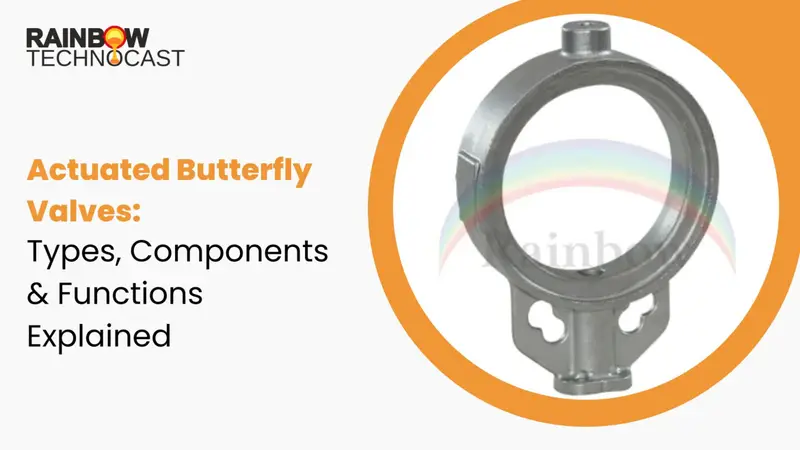
Standard casting tolerances create dimensional variations that translate to inconsistent breakaway torque and unpredictable sealing performance. Near-net investment casting delivers the tight tolerances that eliminate these variables.
Rainbow Technocast’s precision casting expertise addresses the root causes of field failures—dimensional inconsistency, internal stress patterns, and surface finish variations that create premature wear patterns. Their investment casting process produces valve internals with tolerances that ensure predictable torque characteristics and extend sealing life.
The Manufacturing-Performance Connection:
- Precise disc geometry reduces breakaway torque variations
- Controlled surface finishes minimize seat wear and galling
- Stress-relieved castings maintain dimensional stability through thermal cycles
- Quality systems that trace material properties ensure consistent performance across production runs
This precision manufacturing approach transforms valve selection from commodity procurement to reliability engineering.
Decision-Ready Confidence
Actuated butterfly valves drive operational excellence when specification matches application reality and manufacturing precision supports field requirements.
The market growth toward premium actuated solutions reflects operators discovering that reliability engineering costs less than reactive maintenance. Smart specifications account for fouling, thermal cycling, and control loop stability—not just nameplate conditions.
Contact Rainbow Technocast for precision casting solutions that eliminate the manufacturing variables responsible for field failures. Their expertise in complex geometries and tight tolerances ensures that valve internals perform predictably across service conditions, converting specification discipline into operational advantage.
Share your media, temperature, pressure, and duty cycle requirements for specification guidance that de-risks selection and eliminates installation surprises. The difference between valves that work and valves that excel lies in understanding that precision manufacturing enables reliability engineering.