
Introduction
Hose connections in industrial and agricultural operations waste significant labor hours through threaded fittings that require wrenches, alignment time, and multiple workers. Each connection and disconnection consumes 5-10 minutes of productive time, multiplied across dozens of daily transfers. Leaking connections contaminate products, damage equipment, and create safety hazards that halt operations.
Cam and groove fittings eliminate these inefficiencies through tool-free, quarter-turn connections that one person can operate in seconds. The male adapter inserts into the female coupler, and cam arms lock the connection with hand pressure alone. This simple mechanism creates leak-proof seals that withstand full system pressure while enabling rapid disconnection when transfers complete.
This guide explains how cam and groove fittings work across industrial and agricultural applications. You’ll learn which materials match specific fluids, how sizing affects flow capacity, and where installation errors create premature seal failures.
How Cam and Groove Fittings Work?
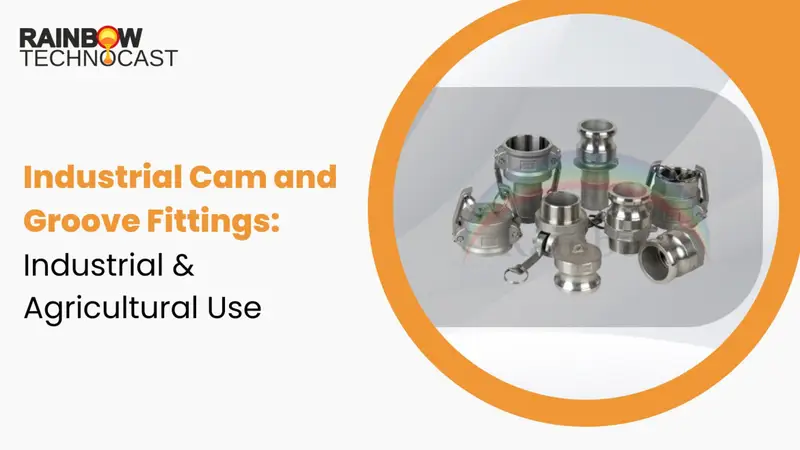
The fitting consists of two components: a male adapter with a groove around its circumference and a female coupler with pivoting cam arms. The male adapter slides into the female coupler until the groove aligns with the cam arms.
Rotating the cam arms down locks them into the groove, pulling the two halves together. A gasket inside the female coupler compresses against the male adapter face, creating the seal. The cam mechanism generates sufficient clamping force to prevent separation under pressure.
Disconnection requires lifting the cam arms back to their open position. The spring-loaded design holds arms in either locked or unlocked positions, preventing accidental disconnection during operation.
Materials and Construction Options
Stainless Steel
Type 316 and 304 stainless steel resist chemical corrosion and handle temperatures from -40°F to 400°F. Food processing, pharmaceutical, and chemical transfer applications specify stainless construction to prevent contamination and extend service life in corrosive environments.
Aluminum
Lightweight aluminum fittings simplify handling in portable applications. Agricultural operations favor aluminum for irrigation system connections where workers move equipment frequently throughout growing seasons.
Brass and Bronze
Brass provides corrosion resistance in water service at lower cost than stainless steel. Municipal water systems and construction dewatering operations use brass fittings for temporary water transfer.
Polypropylene
Plastic fittings handle acids, bases, and other chemicals that attack metal. The lightweight construction suits applications where metal sparking creates hazards or where weight restrictions limit metal fitting use.
Industrial Applications
Chemical plants use cam and groove fittings for loading and unloading tank trucks with solvents, acids, and process chemicals. The quick-connect capability reduces truck dwell time at loading racks, increasing throughput without additional infrastructure.
Oil and gas operations install cam and groove connections on well site equipment, temporary piping, and drilling fluid systems. Field conditions demand fittings that work with gloves in weather extremes without tools or extended connection time.
Food and beverage processors specify sanitary cam and groove fittings for connecting mobile equipment to fixed processing lines. The smooth internal surfaces clean easily and resist bacterial growth between production runs.
Mining operations rely on these fittings for dewatering pumps, slurry transfer, and dust suppression systems. The robust construction tolerates abrasive materials and harsh conditions that destroy threaded connections.
Agricultural Uses
Here’s a surprising reality about modern farming efficiency: irrigation systems lose approximately 30-50% of water through evaporation, leakage, and inefficient distribution. Cam and groove fittings address the leakage component by creating reliable seals that prevent water waste at connection points.
Center pivot irrigation systems use cam and groove connections for rapid mainline assembly and disassembly. Farmers reconfigure layouts between growing seasons without cutting pipe or replacing threaded fittings damaged during removal.
Drip irrigation networks employ these fittings where submain lines connect to lateral distribution pipes. The tool-free connections allow single operators to expand systems as fields require additional coverage.
Fertilizer application equipment connects to supply tanks through cam and groove fittings that resist chemical corrosion. The quick disconnection enables equipment cleaning between different fertilizer types without cross-contamination.
Water transfer pumps in agricultural ponds and wells use these fittings for intake and discharge hoses. The secure connections prevent air leaks that reduce pump efficiency or cause priming failures.
Key Benefits
Cam and groove fittings connect in seconds compared to minutes for threaded alternatives. This speed advantage compounds across operations that make dozens of connections daily, recovering hours of productive labor weekly.
No tools means no wrench damage to fitting surfaces. Threaded connections overtightened with pipe wrenches distort threads and crush gaskets, creating future leakage. Hand-operated cam arms apply consistent clamping force without over-compression.
The reusable design withstands thousands of connection cycles. Gaskets remain the only wear component requiring periodic replacement. Bodies and cam arms function indefinitely in properly sized applications.
Dirty environments don’t prevent operation. Mud, dust, and debris that jam threaded fittings don’t affect cam and groove functionality. A quick wipe of the sealing surfaces restores full sealing capability.
Selection Guidelines
Match fitting size to hose internal diameter and required flow rate. Undersized fittings restrict flow and increase pressure drop. Oversized fittings add weight and cost without performance benefits.
Verify pressure ratings exceed maximum system pressure including surge conditions. Standard designs handle 150-250 psi depending on size and material. High-pressure versions reach 500 psi for specialized applications.
Choose materials compatible with transferred fluids. Aggressive chemicals require stainless steel or polypropylene. Petroleum products work with aluminum or brass. Potable water systems need NSF-approved materials.
Select gasket materials that resist chemical attack and temperature extremes. Buna-N works for petroleum products. EPDM suits water and steam. Viton resists solvents and acids.
FAQs
Q: Can cam and groove fittings handle high-pressure applications?
A: Standard cam and groove designs work reliably up to 250 psi. Specialized high-pressure versions reach 500 psi through reinforced cam arms and heavier body construction. For pressures above this range, consider flanged or threaded connections designed for extreme pressure service.
Q: How often do gaskets need replacement?
A: Gasket life depends on fluid compatibility, temperature cycling, and connection frequency. Chemical service may require annual replacement. Clean water applications can last 2-3 years. Inspect gaskets during routine maintenance and replace when compression set or cracking appears.
Q: Do cam and groove fittings work with vacuum applications?
A: Yes, the cam locking mechanism creates sufficient seal compression for vacuum service. Use full gaskets rather than cam groove seals for maximum vacuum holding capability. Verify the male adapter face remains flat without warping that allows air infiltration.
Q: Can I mix materials between male and female halves?
A: Mixing is possible but not recommended. Dissimilar metals create galvanic corrosion in conductive fluids. Thermal expansion differences between aluminum and stainless steel can affect seal compression across temperature changes. Match materials for optimal performance.
Q: What causes cam arms to slip out of the locked position?
A: Worn cam arm springs lose tension and fail to hold arms locked. Operating fittings above their pressure rating can force arms open. Impact damage to cam arms deforms the locking mechanism. Replace fittings showing cam arm damage or weak spring tension.
Conclusion
Cam and groove fittings transform fluid transfer operations through tool-free connections that reduce labor time, eliminate leaks, and withstand harsh industrial and agricultural environments. Selecting appropriate materials and sizes for your specific application determines whether you achieve reliable service or face repeated connection failures.
Contact our team today to discuss your fluid transfer requirements and receive cam and groove fitting recommendations tailored to your operating conditions.
Rainbow Technocast manufactures precision cam and groove fittings engineered for demanding industrial and agricultural fluid transfer applications. Our fittings deliver reliable, leak-proof connections across chemical processing, oil and gas operations, irrigation systems, and food processing facilities. We supply fittings in stainless steel, aluminum, brass, and polypropylene with custom gasket materials to match your exact fluid chemistry and operating temperatures. Visit rainbowtechnocast.thinkingstation.com/ or reach out to our engineering team for quick-connect solutions that reduce connection time, eliminate tool requirements, and provide years of dependable service in the toughest environments.