
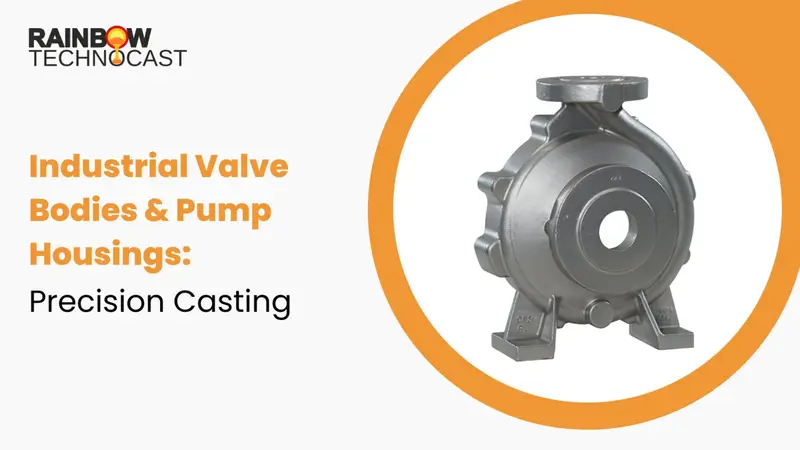
Defective valve bodies and pump housings cost industrial facilities $85,000-$150,000 annually through unplanned downtime, emergency replacements, and lost production. Most failures trace back to casting defects—porosity, dimensional inaccuracies, or material inconsistencies that compromise structural integrity before components even enter service.
Precision casting eliminates these failure modes through controlled processes that deliver dimensional tolerances within 0.005 inches, consistent wall thickness, and metallurgical properties that match design specifications exactly. This accuracy matters because valve bodies and pump housings operate under continuous pressure cycling, thermal stress, and corrosive exposure that amplifies any manufacturing weakness into catastrophic failure.
Here’s what buyers often miss: the cheapest casting isn’t the most economical. Valve bodies requiring extensive machining to correct dimensional errors or pump housings with porosity that limits pressure ratings cost more over their lifecycle than precision castings that meet specifications as-cast.
This guide compares casting methods for valve and pump components, explains material selection criteria, outlines the manufacturing process, and identifies quality factors that separate reliable components from premature failures.
Casting Methods Comparison
Sand Casting for Large Components
Sand casting creates molds from compacted sand mixed with bonding agents, then pours molten metal into cavities. This method handles components from 5 pounds to several tons, making it suitable for large gate valve bodies and industrial pump housings exceeding 24-inch ports.
Dimensional tolerance typically ranges ±0.030-0.060 inches depending on size. Surface finish requires machining on sealing surfaces, flange faces, and threaded connections. Sand casting costs 40-60% less than investment casting for components over 50 pounds where tolerance requirements allow additional machining.
Investment Casting for Complex Geometries
Investment casting builds ceramic shells around wax patterns that melt away during firing, creating precise molds for metal pouring. This process achieves tolerances within ±0.005-0.010 inches and produces near-net-shape components requiring minimal machining.
The method excels for valve bodies with intricate internal passages, pump housings with integrated mounting features, and components requiring superior surface finish. Investment casting handles complex undercuts and internal geometries that sand casting can’t form without cores that complicate mold assembly.
Wall thickness control reaches ±0.015 inches, ensuring consistent strength throughout the casting. This uniformity prevents weak points that initiate cracks under cyclic loading.
Die Casting for High-Volume Production
Die casting injects molten metal under high pressure into steel molds, delivering exceptional dimensional consistency and smooth surfaces. The process suits high-volume production of smaller valve bodies and pump components in aluminum, zinc, and magnesium alloys.
Cycle times range from 30 seconds to 2 minutes depending on size, making die casting the fastest method for producing thousands of identical components. Initial tooling costs reach $50,000-$200,000 but amortize quickly across large production runs that demand consistent quality.
Material Selection Criteria
Matching Alloys to Operating Conditions
Cast iron and ductile iron handle neutral fluids at moderate temperatures while providing good machinability and wear resistance. These ferrous materials suit municipal water systems, HVAC, and general industrial service where corrosion isn’t the primary concern.
Stainless steel grades (CF8M, CF3M) resist corrosive chemicals, high-purity fluids, and sanitary applications in food, pharmaceutical, and chemical processing. The material costs 4-6 times more than iron alloys but eliminates coating requirements and extends service life in aggressive environments.
Nickel-aluminum bronze and other copper alloys combine corrosion resistance with antimicrobial properties for seawater service, marine pumps, and applications requiring biofouling resistance.
Pressure and Temperature Capabilities
Material selection directly determines pressure and temperature ratings. Carbon steel castings handle pressures to 1500 PSI and temperatures exceeding 800°F in power generation and petrochemical service. Ductile iron limits to 600 PSI and 650°F but costs 30-40% less for applications within these ranges.
Verify material certifications include actual test data rather than generic specifications. Mechanical properties vary by heat treatment, cooling rate, and alloy chemistry even within the same material designation.
Key Manufacturing Process Steps
Pattern Development and Mold Creation
Pattern accuracy determines final casting dimensions. Precision patterns account for metal shrinkage during cooling—typically 1-2% for ferrous alloys and 1.5-2.5% for aluminum—ensuring finished components meet specifications after solidification.
Mold preparation includes gating design that controls metal flow rate and direction, minimizing turbulence that traps air and creates porosity. Riser placement ensures adequate metal supply as solidification shrinkage occurs, preventing void formation in critical sections.
Metal Pouring and Quality Control
Pouring temperature affects both castability and final properties. Overheating increases oxidation and gas absorption that leads to porosity. Underheating causes cold shuts where metal streams don’t fuse properly, creating internal defects invisible until failure occurs.
Controlled cooling prevents thermal stress cracking and achieves desired metallurgical structure. Accelerated cooling in specific zones refines grain structure and improves mechanical properties in high-stress regions.
Finishing and Inspection
Machining removes excess material from flange faces, threads, and sealing surfaces while maintaining critical dimensions. CNC machining ensures consistency across production batches, eliminating the hand-finishing variations that cause assembly problems.
Non-destructive testing detects internal defects through radiographic inspection, ultrasonic scanning, or dye penetrant examination. Pressure testing verifies structural integrity before components ship to assembly operations.
Industry Applications
Chemical processing plants demand castings that resist specific corrosive compounds while maintaining pressure ratings to 600 PSI. Valve bodies handling chlorinated hydrocarbons, sulfuric acid, or caustic solutions require stainless or nickel alloys with verified chemical resistance data.
Oil and gas operations use investment-cast valve bodies and pump housings in wellhead equipment, pipeline systems, and refinery processing where failure risks explosion or environmental damage. These applications justify premium casting processes that ensure defect-free components.
Power generation facilities rely on high-temperature castings in boiler feed pumps, condensate systems, and cooling water circulation. Components must withstand continuous operation at design limits without degradation that reduces efficiency.
Advantages of Precision Casting
Complex internal geometries form as-cast without secondary operations that add cost and introduce dimensional errors. Valve bodies with multiple internal passages for pilot operation or pump housings with integrated mounting bosses eliminate welding and machining that weaken structures.
Material utilization reaches 80-90% compared to 40-60% for components machined from bar stock. This efficiency reduces material waste and lowers costs for expensive alloys like duplex stainless or nickel-chromium grades.
Consistent metallurgical properties throughout the casting ensure predictable performance under design loads. Forged or welded assemblies create stress concentrations and material variations that precision castings avoid.
Frequently Asked Questions
Q: What’s the minimum order quantity for precision-cast valve bodies?
A: Investment casting becomes cost-effective at 50-100 pieces depending on complexity. Sand casting works for prototype quantities or runs under 20 pieces. Die casting requires 500+ units to justify tooling investment.
Q: How do casting tolerances compare to machined components?
A: Precision investment casting achieves ±0.005-0.010 inches on critical dimensions. Machining reaches ±0.001-0.002 inches but only on surfaces actually machined. Casting delivers consistent accuracy throughout the component including internal features machining can’t reach.
Q: Can castings handle the same pressure ratings as forged valve bodies?
A: Yes, when properly designed and manufactured. Material properties in quality castings match or exceed forgings. Wall thickness and geometry determine pressure rating, not manufacturing method. Certify actual mechanical properties through testing rather than assuming process superiority.
Q: What lead times should I expect for custom valve body castings?
A: Pattern development and first article casting typically requires 8-12 weeks. Production runs deliver within 4-6 weeks after pattern approval. Rush service cuts these times 30-40% with expediting fees.
Demand Precision in Every Component
Valve bodies and pump housings determine system reliability and maintenance costs for decades after installation. Selecting casting processes and materials based on actual service requirements rather than initial price prevents the emergency replacements and downtime that destroy budgets.
Verify manufacturer capabilities through material certifications, dimensional inspection reports, and pressure test documentation before committing to production quantities. Quality castings include traceability from heat number through final inspection.
Rainbow Technocast specializes in precision casting for valve bodies, pump housings, and fluid handling components across all major casting processes. Our integrated facility handles pattern making, investment casting, sand casting, CNC machining, and final testing under one roof, ensuring dimensional consistency and metallurgical integrity throughout production.
We cast ferrous and non-ferrous alloys from 1 pound to 500 pounds with documented material certifications, pressure testing, and dimensional inspection on every production lot. Our quality systems meet ISO 9001 standards with full traceability from raw material receipt through final shipment.
Ready to specify valve bodies or pump housings for your next project? Contact our engineering team with your drawings, material requirements, and service conditions. We’ll recommend casting processes that optimize cost, performance, and delivery for your specific application.