
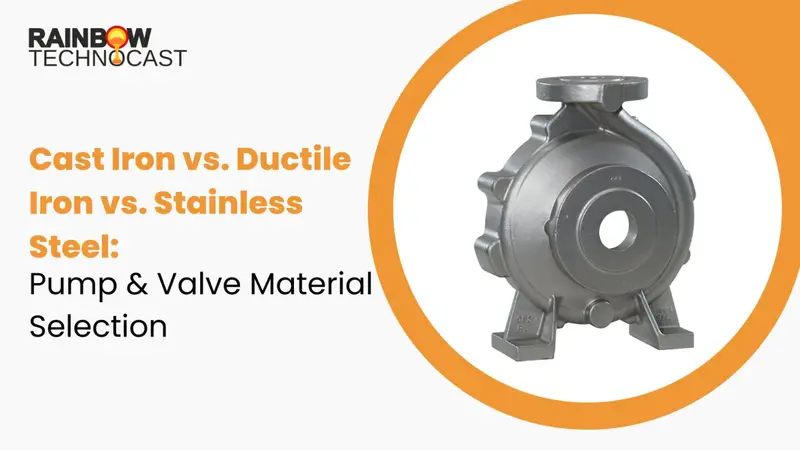
Wrong material choices account for 60% of premature pump and valve failures in industrial plants. Most buyers default to whatever the previous installation used, ignoring critical changes in fluid chemistry, temperature swings, or pressure cycles that demand different materials.
Selecting between cast iron, ductile iron, and stainless steel determines whether your equipment runs for decades or requires replacement within months. This decision impacts corrosion rates, mechanical integrity under stress, and total ownership costs that extend far beyond purchase price.
Here’s the uncomfortable reality: the cheapest upfront option often becomes the most expensive over five years when you factor in downtime, repairs, and emergency replacements. Understanding material properties and matching them to actual operating conditions eliminates guesswork and prevents costly mistakes.
This guide breaks down the mechanical and chemical differences between these three materials, explains when each performs best, and provides selection criteria based on your specific fluid handling requirements.
Cast Iron Characteristics
Strength, Brittleness, and Structural Limits
Cast iron contains 2-4% carbon in flake graphite form, creating a rigid but brittle structure. This material handles compression forces well but fractures under impact or sudden stress changes that ductile materials would absorb.
Tensile strength typically ranges from 20,000-60,000 PSI depending on grade. Cast iron valves and pumps work reliably in stable conditions but crack when subjected to thermal shock or water hammer events.
The brittleness that limits mechanical performance also simplifies machining and casting. Complex internal geometries form easily, reducing manufacturing costs by 30-40% compared to steel alternatives.
Temperature and Pressure Ratings
Cast iron operates effectively between -20°F and 450°F in most applications. Beyond these limits, the material expands or contracts at rates that compromise seal integrity and dimensional stability.
Maximum pressure ratings reach 250 PSI for standard grades, with some high-performance versions handling up to 400 PSI. These limits work for municipal water systems, HVAC, and low-pressure process applications but fail in high-pressure industrial environments.
Corrosion Behavior
Cast iron corrodes gradually in neutral pH water, forming protective iron oxide layers that slow further degradation. Acidic or chlorinated fluids accelerate corrosion rates by 10-15 times, pitting the surface and weakening structural integrity within months.
Protective coatings extend service life but add maintenance requirements. Epoxy linings typical in water service need reapplication every 8-12 years as fluids erode the barrier layer.
Ductile Iron Characteristics
Enhanced Ductility and Impact Resistance
Ductile iron contains the same carbon content as cast iron but processes it into spherical nodules rather than flakes. This microstructure change transforms a brittle material into one that bends before breaking.
Elongation rates reach 10-20% compared to cast iron’s 1% or less. This ductility absorbs shock loads from pump startups, valve slamming, and pressure surges that would shatter cast iron components.
Tensile Strength and Yield Properties
Ductile iron delivers tensile strength between 60,000-120,000 PSI—double to quadruple cast iron’s capacity. Yield strength reaches 40,000-90,000 PSI, allowing thinner wall sections without compromising safety margins.
Higher strength enables pressure ratings up to 600 PSI in valve bodies and pump casings. This capability covers most industrial applications including oil and gas, chemical processing, and high-rise water distribution.
Temperature and Corrosion Performance
Operating temperature range extends from -40°F to 650°F, exceeding cast iron’s limits at both ends. The expanded range suits steam systems, hot oil circulation, and refrigeration applications.
Corrosion resistance matches cast iron in neutral environments but ductile iron’s tighter grain structure resists pitting better in mildly acidic conditions. The material still requires coatings or linings for aggressive chemical service.
Stainless Steel Characteristics
Corrosion Resistance in Harsh Environments
Stainless steel contains minimum 10.5% chromium that forms a passive oxide layer preventing rust and chemical attack. This protection works across pH ranges from 4-10 and handles chlorides, acids, and alkalis that destroy iron-based materials within weeks.
The material maintains corrosion resistance without coatings or maintenance interventions. Surface passivation occurs naturally when oxygen contacts the chromium content, self-healing minor scratches automatically.
Mechanical Properties and Temperature Tolerance
Austenitic stainless steel grades (304, 316) offer tensile strength from 75,000-95,000 PSI with excellent elongation properties. The material resists thermal shock and operates from cryogenic temperatures below -300°F to 1500°F in oxidizing atmospheres.
Stainless steel maintains strength at temperature extremes where iron alloys weaken or become brittle. This stability matters for steam service, heat transfer fluids, and low-temperature applications like LNG handling.
Cost Considerations
Stainless steel costs 4-8 times more than ductile iron and 6-12 times more than cast iron for equivalent components. This price gap narrows when calculating lifecycle costs including maintenance, replacement frequency, and downtime expenses.
Industries processing food, pharmaceuticals, or ultrapure water justify the premium through sanitation requirements and contamination prevention that other materials can’t provide.
Material Selection Factors
Fluid Compatibility Analysis
Evaluate pH levels, chloride content, and suspended solids before selecting materials. Cast iron suffices for clean water between pH 6.5-8.5 but fails rapidly in acidic mine drainage or seawater service where chlorides exceed 500 PPM.
Ductile iron extends the acceptable range slightly but still requires protective measures above 1000 PPM chlorides. Stainless steel remains the only viable option for bleach solutions, salt water, or fluids containing sulfuric or hydrochloric acid.
Operating Conditions Assessment
Match pressure and temperature ratings with actual system demands plus 20% safety margin. Specify ductile iron over cast iron whenever pressure exceeds 150 PSI or temperature cycles vary more than 100°F within 24 hours.
Consider transient conditions like pressure spikes during pump starts, valve closures, or emergency shutdowns. These events impose stresses that exceed steady-state ratings and require materials with impact resistance.
Total Cost Analysis
Calculate replacement frequency based on corrosion rates and mechanical wear patterns. Cast iron valves in corrosive service need replacement every 5-7 years while stainless equivalents run 25-30 years, reversing the cost advantage despite higher initial expense.
Include downtime costs in the calculation. Emergency failures during production runs cost $50,000-$200,000 per incident in lost product and restart delays.
Frequently Asked Questions
Q: Can cast iron and ductile iron components mix in the same system?
A: Yes, but maintain consistent pressure ratings and avoid galvanic coupling without dielectric isolation. The materials have similar corrosion potential so galvanic action is minimal in most fluids. Match flange ratings and gasket materials for proper sealing.
Q: Why choose ductile iron over stainless steel when corrosion isn’t a concern?
A: Cost savings reach 75-85% for ductile iron in applications handling neutral fluids at moderate temperatures. The strength and durability meet requirements without the premium stainless commands. Save stainless for applications that genuinely need corrosion resistance.
Q: Does stainless steel require special welding or fabrication?
A: Stainless demands controlled heat input and specific filler metals to prevent sensitization that reduces corrosion resistance. Most fabricators handle these requirements routinely, but field modifications cost more than iron alloy repairs.
Q: How long do protective coatings last on iron materials?
A: Epoxy and fusion-bonded coatings typically last 10-15 years in water service before requiring reapplication. Abrasive fluids or high velocities reduce coating life to 5-8 years. Factor recoating costs and downtime into lifecycle calculations.
Make the Right Material Choice
Material selection determines whether your pump and valve investments deliver reliable service or become recurring maintenance problems. Match materials to actual operating conditions rather than defaulting to whatever worked before or costs less upfront.
Start by documenting fluid chemistry, temperature ranges, and pressure requirements including transients and worst-case scenarios. Use this data to eliminate materials that can’t meet the demands, then compare lifecycle costs among remaining options.
Rainbow Technocast manufactures precision-cast pump bodies and valve components in cast iron, ductile iron, and stainless steel grades matched to your application requirements. Our casting processes deliver tight tolerances and consistent metallurgy that eliminate weak points and premature failures.
We help buyers specify the right material based on actual service conditions—not assumptions or outdated practices. Every component meets documented pressure ratings, temperature limits, and corrosion resistance verified through independent testing.
Need material guidance for your next pump or valve project? Contact our engineering team with your fluid specifications and operating parameters. We’ll recommend materials that balance performance, longevity, and cost for your specific application.