
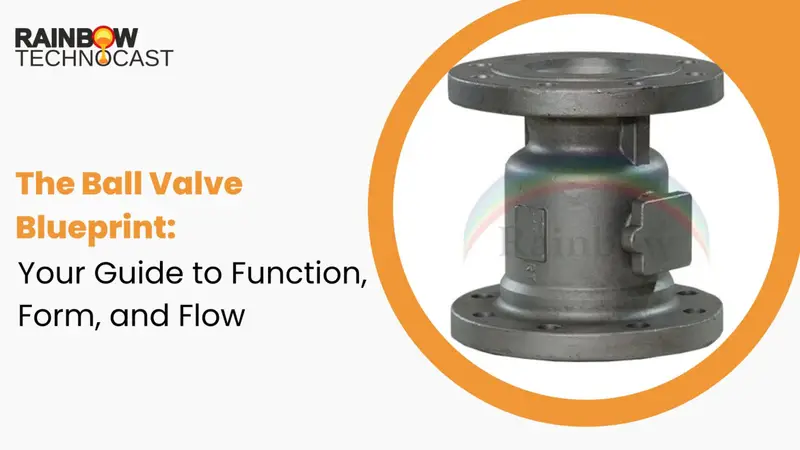
Ball valves are everywhere because they work—fast, tight, and simple—yet they’re mis-specified far more often than anyone wants to admit. As one practical primer puts it, “A ball valve is a quarter turn shut-off valve that controls the flow of fluids by a rotary ball.” That’s the clear, elegant mechanism buyers love—and the very simplicity that invites lazy choices.
Where we fit (and only here): Rainbow Technocast supplies precision-cast valve components—bodies, balls, stems, end connections—engineered for the tolerances and surface finishes that make shutoff actually shut off. Now, let’s earn your trust with specifics, not slogans.
2) What a Ball Valve Is & How It Works
Start at first principles. In the open position, “the ball rotates so that its bore aligns with the flow path,” allowing near-full-bore flow. Rotate 90°, and the bore turns perpendicular to the line; flow stops. The entire actuation arc is just a quarter turn, which is why ball valves are prized for on/off isolation and favored for automation.
A widely used buyer’s summary keeps it blunt: “Ball valves are one of the most common valve types… They are typically used for basic on/off service.” Translation: if you’re throttling, you’re probably in the wrong neighborhood—or you need a special trim.
3) Core Construction & Key Components
Structure drives behavior. Most industrial ball valves are built around a body (one-, two-, or three-piece), a precision-machined ball with a through-bore, two seats that provide the primary seal, a stem that transmits torque, and a packing stack that keeps fugitive emissions where they belong—inside the valve. End connections (threaded, flanged, butt-weld) determine pressure class and maintenance realities. Trunnion designs add a fixed lower shaft to support the ball, stabilizing alignment and reducing seat load—especially valuable in high-pressure or large-diameter service. As one explanation notes, “Unlike the more common ‘free floating’ ball valve design, trunnion ball valves… ensure the ball remains firmly in place.”
4) Flow & Circuit Functions (2-Way vs 3-Way)
Two-way ball valves do what the label says: isolate. Three-way valves expand the playbook—diverting, mixing, or selecting between sources. The internal bore pattern is the whole story:
- L-port: “divert flow between two ports at a 90-degree angle.”
- T-port: “can mix fluids and direct flow between all three ports.”
Use L-port for either/or routing; use T-port where blending or flexible routing logic is required. Many buyers over-specify a 3-way when two 2-ways with interlocking logic would do—don’t add complexity you won’t maintain.
5) Valve Types (Comparisons Buyers Make)
Full-port vs reduced-port. Full-port (full-bore) minimizes pressure drop; reduced-port saves cost and weight but raises velocity. The right answer is about energy and erosion: if ΔP matters or abrasives are present, full-port earns its keep.
Body construction: one-, two-, three-piece. One-piece bodies minimize leak paths and cost; two-piece add serviceability at the ends; three-piece bodies are the maintenance team’s best friend because you can service the seats and ball without cutting the valve out. One manufacturer puts it crisply: “3-piece ball valves offer the ability to remove components for cleaning or repairs, sometimes while the valve body is still in place.” That drives lifecycle economics more than list price ever will.
Special trims (use them on purpose).
- V-port: machined V-notch in the ball adds a quasi-linear control characteristic—great for coarse control where you still want the ball valve’s ruggedness.
- Multi-port: routing logic in a compact envelope; verify the pattern drawing—assumptions break processes.
- Sanitary: crevice-free surfaces and CIP/SIP compatibility for food, pharma, and fine-chem.
6) Advantages & Disadvantages (The Reality Check)
What ball valves do brilliantly
- Tight shutoff with compact geometry and fast quarter-turn actuation.
- Low pressure drop in full-port.
- Easy automation; predictable torque curves; wide material options.
Where they bite back
- Throttling erodes seats and edges unless you spec the right trim.
- Particulates can scar seats; dry gas at high ΔP can howl (noise) and cavitate downstream in liquids.
- Elastomer seats cap your temperature ceiling; choose seat chemistry to match media and heat.
“Most common” doesn’t mean “one-size-fits-all.” In critical duty, the engineering lives in the seat selection, stem sealing, and actuation envelope—not the catalog glamour shot.
7) Applications & Approvals Context
Ball valves live across water, air, steam, inert gases, fuels, solvents, and slurries (with caution). For regulated services, approvals and standards aren’t nice-to-have—they’re table stakes.
- API 608 vs API 6D. One helpful comparison: “API 608 refers to specifications for flanged, threaded, and welded ball valves made from metal, whereas API 6D refers to specifications for piping and pipeline valves.” If you’re in pipelines, 6D is your language; in plant piping, 608 often rules—confirm your scope.
- Pipeline reality. Another summary states that long-distance pipeline ball valves require “higher safety reliability, tightness and strength” than general 608 valves because replacement is difficult and failure consequences escalate. In other words, spec like your crew has to live with it for 20 years—because they do.
8) Selection Criteria (How to Choose Wisely)
Selection is not a vibe; it’s a checklist backed by operating conditions. A widely used framework says it plain: “STAMPED is an acronym which stands for: Size, Temperature, Application, Material/Media, Pressure, Ends, and Delivery.” Run STAMPED before you argue about brand names.
Read this section like a control room sticky note:
- Size to the energy, not the pipe label. Match Cv to the flow regime you actually run, then check velocity and erosion risk at worst-case conditions.
- Temperature decides seat chemistry. PTFE, reinforced PTFE, PEEK, UHMWPE, filled composites—each has a curve. Hot oil ≠ hot steam.
- Application trumps opinion. Isolation is easy; clean throttling is not. If you must throttle, consider V-port or a control valve.
- Material/Media is your compatibility truth. Chlorinated solvents, sour service, oxygen—each brings different metallurgy and cleaning rules.
- Pressure is a system, not a point. Look at startup/shutdown transients, pump trips, and thermal expansion. The ball doesn’t care about nominal; it responds to actual.
- Ends are economics. Threaded for small/low-risk; flanged for maintenance; butt-weld where leak paths must disappear.
- Delivery is strategy. Don’t strand a line waiting for a non-stock seat set. Standardize spares with intent.
One more buyer sanity check: If you’re tempted to upsize “just to be safe,” run the ΔP. Oversizing can kill control and invite seat chatter during partial opens.
9) Sizing, Installation & Maintenance Essentials
Sizing. Resist the urge to pick by line size alone. Confirm required Cv, velocity, and pressure drop at minimum, normal, and maximum flows. In abrasives, keep velocity down; in gas, watch choked-flow conditions and noise limits.
Installation. Align flanges; support the pipe so the valve isn’t carrying your misalignment sins; verify handle/actuator travel is unobstructed. For 3-ways, double-check the port map—an inverted symbol on a P&ID can cause memorable startup days.
Maintenance. Three-piece bodies can cut downtime dramatically. As one practical explainer notes, “the 3-piece ball valve is the most durable… components [can be] removed for cleaning or repairs, sometimes while the valve body is still in place.” That means you can change worn seats and packings to suit new media or refresh aging elastomers without cutting out the body—lifecycle wins that accountants eventually notice.
Actuation lifecycle. If you automate, size the actuator with margin for worst-case seat friction (cold start, fouling). Add position feedback for proof testing and trend torque signatures; rising torque is a leak forming in slow motion.
10) Wrap-Up: The Ball Valve Decision Framework
If you remember nothing else, remember this pattern:
- Decide the function first: isolate, divert, mix, or (carefully) throttle.
- Choose the form to match the job: full vs reduced port; one- vs three-piece; floating vs trunnion.
- Engineer the flow: Cv, ΔP, velocity, and erosion—run the numbers before you run the plant.
- Lock in the standards: API 608/6D, pressure class, seat and packing certifications that match the medium.
- Build for maintenance: the best valve is the one your techs can keep perfect with the fewest badges and the least downtime.
A few closing lines your team can pin up:
- “They are typically used for basic on/off service.” If you’re throttling, own that decision and spec for it.
- “L-type valves… divert,” “T-type valves… can mix.” The letter inside the ball writes your process logic—read it.
- “Trunnion… ensures the ball remains firmly in place.” Size and pressure often justify the upgrade.
- “STAMPED… Size, Temperature, Application, Material/Media, Pressure, Ends, and Delivery.” Use it as your pre-PO ritual.
Final take: Ball valves succeed because they’re simple. They fail when we pretend our process is simple too. Spec the seat to the insult, the body to the maintenance reality, and the actuation to the worst day in the plant—not the best.
If you want a build partner that quietly makes those choices easier, Rainbow Technocast supplies precision-cast components for ball valves that hold tolerances, surface finishes, and metallurgy across real-world conditions—so your isolation valves don’t just look right on paper; they stay right in service.