
Manufacturing discipline, not marketing, decides reliability. Consider the test backbone most buyers cite: Shell tests are required for all gate, globe, plug, check, floating ball, and butterfly and trunnion mounted ball valves. That’s API 598 telling you where the bar sits before a valve ever sees a plant.
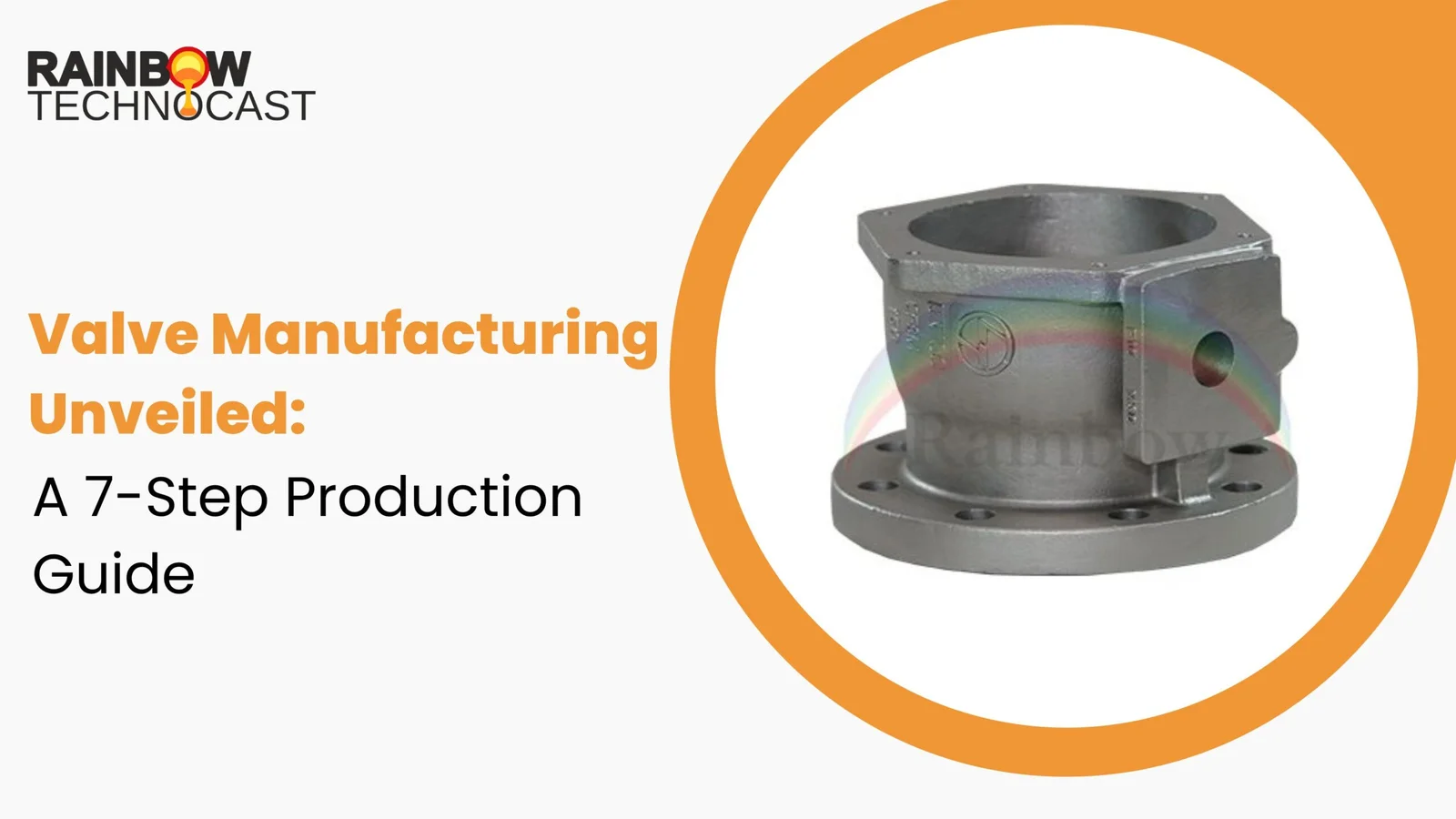
Rainbow Technocast supplies precision investment-cast components used by valve OEMs—near-net bodies, discs, and stems engineered to machine cleanly and document cleanly.
I. Design Inputs & Material Selection
Good valves are born in constraints: pressure/temperature (ASME B16.34 tables), medium, cycle life, fugitive emissions, cleanability. Design teams lock the envelope, then choose the route—cast, forged, or bar stock—based on mechanical properties and manufacturability. ASME reminds you the ratings move with material: use the material reference when determining pressure/temperature limits.
Provocation: Treat “material” as a system: chemistry + process + heat treatment + surface + inspection. Change one, you rewrite the risk.
II. Casting Pathways in Valve Manufacturing
Sand casting excels at size and cost; investment casting (lost-wax) wins where geometry, surface finish, and near-net accuracy cut machining time. The Investment Casting Institute puts it bluntly: “Production of castings which require only minimum machining… Often, parts need no machining and may be used as cast.” It even quantifies finish: “40 to 125 microinches rms” as-cast, “32 microinches rms” with secondary finishing.
Payoff: Near-net saves hours at the spindle and preserves dimensional stock for critical sealing features—exactly where quality bleeds budget.
III. Forging Pathways
When fatigue and shock matter, forging’s grain flow advantage dominates. One industry source notes: “The grain flow of a forging ensures strength at critical stress points.” That’s why high-pressure trims and small bodies often go forged or use forged subcomponents.
Tactical truth: If you’re cycling hard at temperature, forge the parts that fail first; cast the rest for cost and complexity. Hybrids win bids.
IV. Machining & Finishing
Casting or forging only gets you a promising shape. Precision arrives in CNC: true bores, perpendicular faces, tight seat pockets, stem tolerances. Shops chase concentricity and circular runout so seats load evenly, then deburr seal edges to avoid cutting elastomers. The sequence matters: rough → heat treat (if applicable) → finish → gauge. Control-valve handbooks anchor the discipline—process first, accessories second.
Zinger: Geometry is policy. If the machine room cheats, the medium will veto.
V. Heat Treatment
Properties are paid for in furnaces. Quench-and-temper for carbon/low-alloy steels; solution and stabilization for stainless and nickel alloys. For clad/overlay systems, timing matters: industry notes remind that tempering ranges can be selected so heat treatment doesn’t compromise corrosion-resistant overlays.
Payoff: Heat treat is not a checkbox; it’s the difference between a cert that reads “meets minimums” and a part that survives starts/stops.
VI. Surface Engineering & Coatings
Water-service valves often use fusion-bonded epoxy (FBE); manufacturers point to its abrasion/corrosion resistance and potable approvals.
For sour or chloride-rich duty, CRA weld overlay (Alloy 625, 316L, etc.) creates a metallurgical barrier on carbon steel. As one technical institute frames it: “Corrosion-resistant weld overlays are used to improve the service life of components made with an otherwise corrosion-prone material.”
Provocation: Stop buying full-CRA bodies by reflex; overlay the wetted surfaces and spend the delta on controls and diagnostics.
VII. Inspection & NDE
Inspection isn’t theater; it’s sampling the manufacturing truth.
- Liquid penetrant (PT): “Detecting discontinuities that are open to the surface such as cracks, seams, laps, cold shuts, shrinkage… through leaks.”
- Magnetic particle (MT): “A nondestructive method… for detecting cracks and other discontinuities at or near the surface in ferromagnetic materials.”
- UT/RT where wall and weld integrity must be proven beyond the surface.
Payoff: Specify the method + extent + acceptance. “Do PT” is vague; “PT on all pressure-retaining surfaces after machining, per ASTM E165, acceptance: no linear indications” is enforceable.
VIII. Assembly & Traceability
Cleanliness, torque, and orientation are the last honest miles. OEM guidance is boring and right: “Reassemble… following the manufacturer’s guidelines and torque specifications.” Get this wrong and you cut seat life in half on day one.
Traceability is moving from paper to QR/RFID. L&T Valves’ ValvTrac is a live example: QR-coded valves that reveal product details and documents on scan; RFID tags that link to test certificates and IOMs. “Information at your fingertips.” That’s what auditors and maintainers want.
IX. Pressure & Functional Testing (read this like a spec, not a story)
Body vs Seat. ASME B16.34 bodies are commonly tested at 1.5× rated pressure; seat tests at 1.1×—tables are explicit.
API 598 Scope. “Shell tests are required… Closure tests are required…”
Leakage Classes. ISO 5208 defines multiple rates; “Rate A” is the highest grade (no visible leakage)—often applied to soft-seated isolation.
Skimmable essentials:
— Define test fluid (air/gas/water) and duration.
— Demand seat test both directions where applicable.
— Accept witnessed tests only when risk justifies it; otherwise insist on digital test records and photos.
— Specify no coating over pressure boundaries until after hydro.
Zinger: A pretty paint job before hydro is camouflage.
X. Optional / Special Tests (use when risk pays the premium)
Cryogenic (BS 6364). Validates seating and operability at temperature; critical for LNG and low-temp gases.
Fire-safe (API 607/6FA, ISO 10497). Proves limited leakage after burn and cooldown; “evaluate external leakage, through-seat leakage, and ability to be operated after exposure.”
Fugitive emissions (ISO 15848). Confirms low leakage at stem/packing across thermal cycles—boardroom-level ESG meets maintenance reality.
Payoff: Don’t “collect” tests. Choose the ones your hazard analysis would demand if you had to sign the affidavit.
XI. Documentation, Marking & Pack-Out
If it isn’t documented, it didn’t happen. EN 10204 3.1 certificates provide traceable actual test results for the lot, signed by the manufacturer’s authorized representative independent of production.
MSS SP-25 standardizes what’s on the nameplate and body—manufacturer, rating, materials, trim identification—so installers and inspectors aren’t guessing. “Trim identification marking is required on the identification plate…”
Packaging isn’t bubble wrap; it’s corrosion control and mechanical protection so the valve you spec is the valve that arrives.
XII. Buyer’s Checklist for OEM Procurement (fast, enforceable, defensible)
1) Manufacturing route. Cast, forged, or hybrid—and why.
2) Heat treat. Full records tied to heat numbers.
3) NDE scope. Method + extent + acceptance per ASTM guides (E165/E709).
4) Machining tolerances. Especially seat pockets, stem bores, bore roundness.
5) Coatings & overlays. Standard referenced (AWWA C550 for FBE; overlay alloy & procedure per ASME IX).
6) Testing. API 598 edition, ISO 5208 leakage rate, ASME B16.34 pressure basis—and raw test data.
7) Marking & traceability. MSS SP-25 marks; digital/QR access to documents.
8) Documentation pack. EN 10204 3.1 (or 3.2 where justified), IOM, spares list, coatings sheet.
Memorable line: Your paperwork should be as tight as your pressure boundary.
XIII. Conclusion: From Melt to Market Confidence
Valve reliability isn’t a mystery; it’s a chain. Investment casting makes complex shapes economical; forging puts grain where the load lives; machining and heat treat lock tolerances and properties; NDE hunts the defects you can’t afford; pressure tests give you the only answer that matters: seal or leak. The standards are there to be used, not waved: API 598 for test discipline, ISO 5208 for leakage classes, MSS SP-25 for unambiguous marking, ASME B16.34 for pressure/temperature truth. If your current supplier treats them as décor, move.
If you’re building or scaling a valve program, Rainbow Technocast provides precision investment-cast components—including valve bodies and internals for ball, gate, globe, and check—that help OEMs get repeatable geometry, cleaner machining, and cleaner documentation from RFQ to inspection.
Verbatim highlights
- “Production of castings which require only minimum machining… Often, parts need no machining.”
- “The grain flow of a forging ensures strength at critical stress points.”
- “Penetrant testing is a nondestructive testing method for detecting discontinuities that are open to the surface.”
- “Trim identification marking is required on the identification plate…”
- “Shell tests are required for all … valves.”
Zinger to remember: Mass looks sturdy; process makes it safe.