
Introduction
Stainless steel ball valves are among the most widely bought valves in Indian process plants. They isolate chemicals, steam condensate, food products, solvents and utility lines across thousands of sites. Because “SS ball valve” appears on so many quotations, it is easy to assume that all of them are the same.
They are not. Two valves with identical labels can differ in the stainless grade, the quality of the body casting, the seat material and the level of testing. This guide explains the main types and grades, the standards that matter, how to evaluate a stainless steel ball valve manufacturer in India, and the buying mistakes that lead to early leaks and failures.
What Is a Stainless Steel Ball Valve?
How a Ball Valve Works
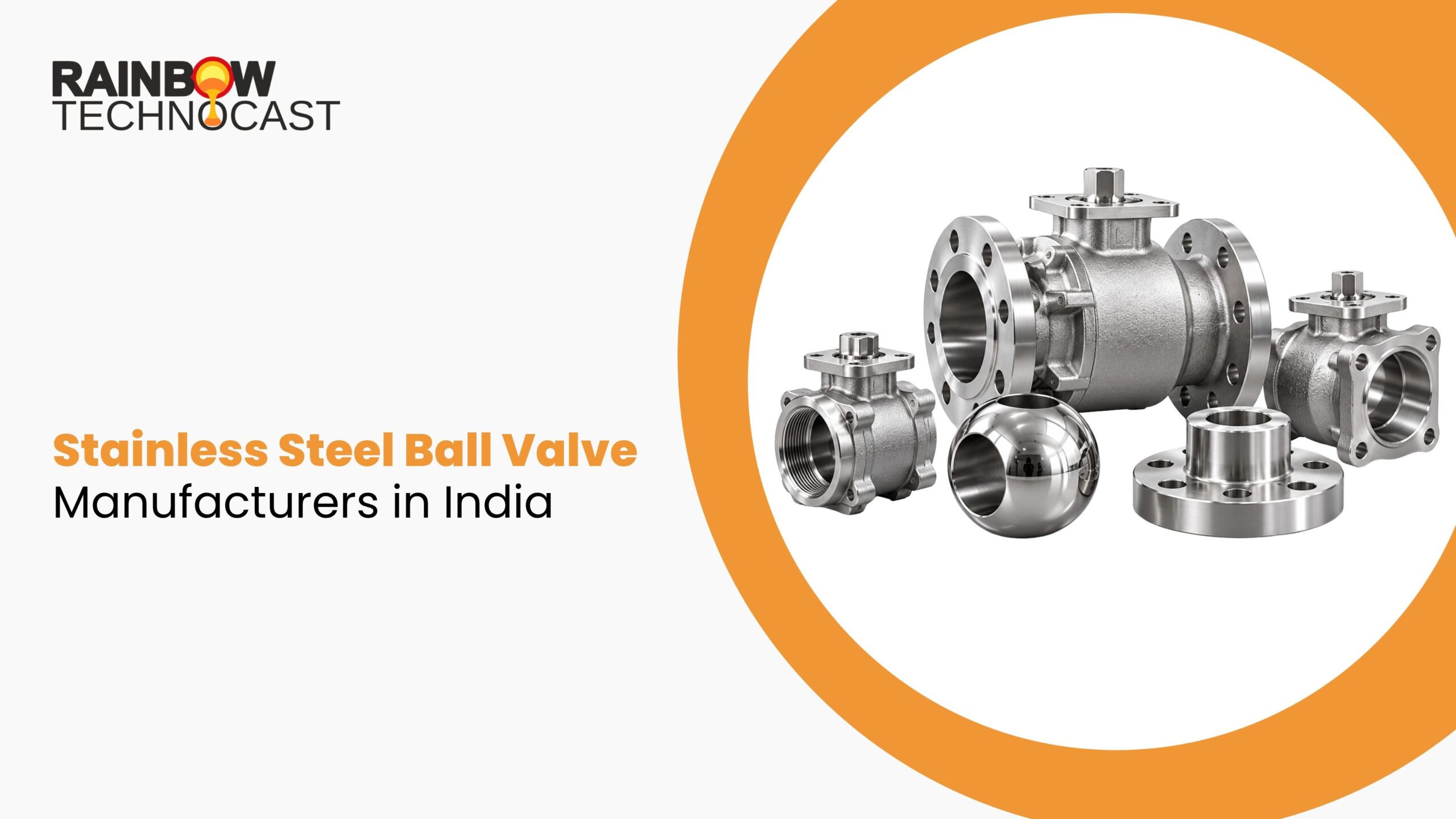
A ball valve uses a ball with a hole (bore) through it. When the bore lines up with the pipe, fluid flows. A quarter turn of the stem rotates the ball so the solid side faces the flow, and soft or metal seats seal against it. The action is quick, simple and gives tight shut-off.
Why Stainless Steel
Stainless steel resists corrosion, handles a wide temperature range and is easy to clean. It is the standard choice for:
- Chemical and process plants
- Food, beverage and dairy
- Pharmaceutical and biotech
- Water treatment and desalination
- Oil, gas and petrochemical utilities
Types of Stainless Steel Ball Valves
By Construction
- One-piece – single body; economical but cannot be repaired
- Two-piece – body and end cap; the most common general-purpose design
- Three-piece – centre body with two end caps; the centre section swings out for maintenance without removing the ends from the line
By Ball Support
- Floating ball – the ball is held by the seats, and line pressure pushes it against the downstream seat. Common for small and medium sizes at lower pressure classes.
- Trunnion mounted – the ball is fixed on top and bottom trunnions, and spring-loaded seats press against it. Used for larger sizes and higher pressures, as operating torque stays lower.
By Bore
- Full bore – the bore matches the pipe size, giving minimal pressure drop and allowing pigging
- Reduced bore – the bore is one size smaller; lighter and cheaper
By End Connection
- Threaded (BSP or NPT)
- Socket weld
- Butt weld
- Flanged (ASME B16.5, EN 1092-1 and others)
- Tri-clamp for hygienic service
Special Designs
- Jacketed – for fluids that must be kept hot, such as molten sulphur or resins
- Cryogenic – extended bonnet for liquefied gases
- Multi-port – three-way or four-way flow diversion
- Fire-safe – designed and tested to keep sealing after seat burn-out
Stainless Steel Grades Used
Valve bodies are usually cast, so cast grade designations under ASTM A351 apply.
CF8 (304) and CF8M (316)
- CF8 – cast equivalent of 304; good for water, air and mild chemicals
- CF8M – cast equivalent of 316; contains about 2–3% molybdenum, which greatly improves resistance to pitting and chlorides
CF3 and CF3M (Low Carbon)
The low-carbon versions of CF8 and CF8M. They reduce the risk of sensitisation and intergranular corrosion after welding, so they are preferred for butt-weld valves and corrosive service.
Duplex and Super Duplex
Duplex grades under ASTM A995 combine austenite and ferrite. They offer higher strength and far better chloride resistance, which makes them suitable for seawater, offshore and high-chloride process service.
Grade Comparison Table
The Pitting Resistance Equivalent Number (PREN = Cr + 3.3×Mo + 16×N) gives a simple comparison of pitting resistance.
| Grade | Wrought equivalent | Approx. PREN | Typical use |
| CF8 | 304 | ~18–20 | Water, air, mild chemicals |
| CF8M | 316 | ~23–26 | Chemicals, chlorinated water, food |
| CF3M | 316L | ~23–26 | Welded and corrosive service |
| Duplex (e.g. 4A) | 2205 | ~33–36 | Seawater, brine, offshore |
| Super duplex (e.g. 5A/6A) | 2507 type | ~40+ | Severe chloride service |
A practical pattern: in coastal plants or chlorinated water lines, many CF8 valves show pitting within a few years, while CF8M valves in the same line last much longer. The price difference between the two grades is usually small compared with the cost of one shutdown.
Seat and Seal Materials
- PTFE – wide chemical resistance; the standard choice up to about 200 °C
- Reinforced PTFE (RPTFE) – glass- or carbon-filled for higher pressure and wear resistance
- PEEK – higher temperatures and pressures
- Metal seats – for abrasive, high-temperature or slurry service
Stem seals and body gaskets, often PTFE or graphite, must also suit the fluid and temperature.
Standards and Certifications
Design Standards
- API 6D – pipeline and piping valves
- API 608 – metal ball valves for flanged, threaded and welding ends
- ISO 17292 – metal ball valves for petroleum, petrochemical and allied industries
- ASME B16.34 – pressure-temperature ratings, wall thickness and materials for steel valves
Testing Standards
- API 598 – inspection and pressure testing of valves
- ISO 5208 – pressure testing and seat leakage rates
Fire-Safe and Emissions
- API 607 / ISO 10497 – fire testing of soft-seated quarter-turn valves
- ISO 15848-1 – fugitive emission classification
Sour Service
- NACE MR0175 / ISO 15156 – material requirements for H₂S-containing environments
How to Evaluate a Stainless Steel Ball Valve Manufacturer
Casting and Forging Source
The body and end caps carry full line pressure. Ask whether bodies are investment cast, sand cast or forged, and who makes them. Investment-cast bodies usually give better surface finish, accurate wall sections and fewer surface defects in small and medium sizes.
Material Verification
Ask for:
- Material test certificates to EN 10204 3.1 for body, ball and stem
- Positive material identification (PMI) on finished valves
- Spectrometer reports from the foundry
Here is the uncomfortable truth. The label “SS ball valve” does not always mean every wetted part is stainless, or that the stainless is the grade stated. Some low-cost valves use a 316 ball with a lower-grade body, or a CF8M body with molybdenum below the minimum. PMI testing on receipt is one of the cheapest ways to catch this.
Ball and Seat Machining
The sealing performance depends on ball roundness and surface finish. Ask how balls are machined, ground and lapped, and how roundness is checked.
Testing Facilities
Every valve should pass:
- Shell hydrostatic test
- Seat leakage test (low-pressure air and high-pressure hydro, as required)
- Operating torque check
- Fire-safe and emission tests for qualified designs
Certifications and Third-Party Approval
Look for ISO 9001, API monogram licences where required, PED compliance for exports to Europe, and experience with third-party inspection agencies for EPC projects.
Customisation and Automation
Check whether the manufacturer can supply ISO 5211 mounting pads, extended stems, special end connections and actuated packages with pneumatic or electric actuators.
Delivery, Spares and Support
Confirm lead times, seat and seal kit availability, and response time for site issues.
Applications
- Chemical and petrochemical plants
- Oil and gas utilities and process lines
- Food, beverage and dairy processing
- Pharmaceutical and biotech plants
- Water treatment and desalination
- Pulp and paper
- Power plant auxiliary systems
- Marine and offshore systems
Common Buying Mistakes
- Choosing CF8 for chloride service. CF8M or duplex is usually the safer choice.
- Ignoring seat temperature limits. The PTFE seat, not the stainless body, often sets the valve’s temperature limit.
- Accepting certificates without verification. Always match heat numbers on certificates to markings on the valve.
- Skipping the casting question. Porosity in a body casting can pass a short test and leak later.
- Mixing standards. API 6D and API 608 valves differ in design and testing; specify the one your project needs.
Buyer’s Checklist
- Define fluid, pressure, temperature, size and end connection.
- Choose floating or trunnion design.
- Specify body, ball, stem and seat materials separately.
- Name the design and testing standards.
- Ask for fire-safe, emission or sour service compliance if needed.
- Request material certificates and PMI reports.
- Ask about the source and quality control of body castings.
- Review test procedures and witness tests where possible.
- Confirm spares and after-sales support.
FAQs
What is the difference between CF8 and CF8M ball valves?
CF8 is the cast equivalent of 304 stainless steel. CF8M is the cast equivalent of 316 and contains molybdenum, which gives better resistance to pitting and chloride attack.
When should I choose a trunnion-mounted ball valve?
Trunnion designs suit larger sizes and higher pressure classes. Because the ball is fixed, operating torque is lower and seats wear less under high differential pressure.
Which standard should a stainless steel ball valve follow?
It depends on the application. API 6D is common for pipelines, API 608 and ISO 17292 for process plants, and ASME B16.34 for pressure-temperature ratings.
How can I verify the stainless steel grade of a ball valve?
Ask for EN 10204 3.1 material certificates and carry out PMI testing on the body and ball. Check that heat numbers on the valve match the certificates.
Are stainless steel ball valves suitable for seawater?
Standard CF8 and CF8M valves can suffer pitting in seawater. Duplex or super duplex stainless steel is generally recommended for seawater and high-chloride service.
Conclusion
A reliable stainless steel ball valve depends on the right grade, a sound body casting, well-machined balls and seats, and verified testing. When evaluating manufacturers in India, look past the label and check material certificates, casting sources and test records.
Before your next order, add PMI testing and casting-source questions to your valve enquiry and compare suppliers on the answers.
About Rainbow Technocast
Rainbow Technocast manufactures ball valve castings for valve manufacturers from Shapar, Rajkot. We investment cast bodies, end caps, bonnets and related components in CF8, CF8M, CF3, CF3M, duplex, super duplex and nickel alloys, cast close to final shape for reduced machining and consistent wall sections.
Our three foundries and two machining shops handle the full route from tooling to finished part. Every heat is checked by spectrometer, and castings are tested through radiography, DPI, MPI, mechanical testing and hydro-pressure testing as specified. Our approvals include ISO 9001, API 20A, PED 2014/68/EU, AD 2000-Merkblatt W0, NORSOK M-650, IBR and Lloyd’s Register.
Our promise: stainless ball valve castings with verified chemistry and sound metal, built for leak-tight service.
Send your ball valve body or end cap drawing through our contact page for a technical review and quotation.