
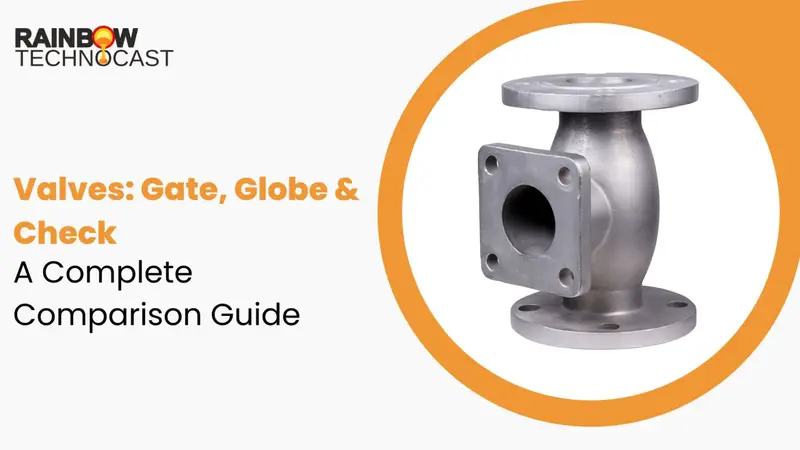
Specifying the wrong valve type costs industrial facilities more than money—it creates premature failures, safety hazards, and process inefficiencies that compound over time. Industry data reveals that 51% of valve-related maintenance issues stem from initial selection errors rather than manufacturing defects, yet most buyers default to gate valves for every application without considering alternatives. The problem intensifies because gate, globe, and check valves serve fundamentally different purposes—forcing a gate valve into throttling service destroys seats, while using globe valves for isolation creates unnecessary pressure drop. Each valve type excels in specific conditions and fails catastrophically in others. Understanding the mechanical differences, performance characteristics, and proper application criteria prevents costly mistakes during specification. This guide examines how each valve operates, where each design excels, and which selection factors determine optimal performance across industrial applications.
Design and Operating Principles
Gate valves lift a wedge-shaped disc perpendicular to the flow path. When fully open, the gate retracts completely from the flow stream, creating an unobstructed passage with minimal pressure drop. The linear motion requires multiple turns to operate—typically 5-7 full rotations for complete travel.
Globe valves use a movable plug that seats against a stationary ring perpendicular to flow direction. The tortuous flow path creates a Z-shaped route through the valve body. This design enables precise flow modulation but generates significant pressure drop even when fully open.
Check valves prevent reverse flow automatically without external control. Internal discs or flappers open under forward pressure and close when flow reverses or stops. Swing check, lift check, and dual-plate variants accommodate different installation requirements.
Performance Characteristics
Gate valves provide full-bore flow capacity with pressure drop typically under 1 PSI when fully open. Bi-directional sealing works equally well in either flow direction. The design fails in throttling applications—partially open gates experience flow-induced vibration that erodes seats rapidly.
Globe valves deliver superior throttling control through precise plug positioning. Pressure drop ranges from 3-10 times higher than equivalent gate valves due to directional flow changes. Most globe valves operate unidirectionally with flow entering under the seat to reduce stem stress.
Check valves operate passively based on differential pressure. Response speed varies by design—swing checks close slowly and can cause water hammer, while spring-loaded lift checks snap shut quickly. Pressure drop depends on internal geometry and flow velocity.
Application Suitability
Gate valves dominate on-off isolation service in pipelines, tank connections, and process isolation points. Clean liquids and gases work best—suspended solids damage seats during closing. Sizes range from ½” to 48″ across pressure classes from 150# to 2500#.
Globe valves serve throttling applications requiring continuous flow adjustment. Bypass lines, pressure reduction stations, and temperature control systems rely on globe valve precision. The design handles erosive service better than gate valves because flow direction assists seating.
Check valves install downstream of pumps, compressors, and vertical risers to prevent backflow damage. Pump discharge lines use check valves to prevent reverse rotation during shutdowns. Compressor applications require non-slam designs that close before flow reverses.
Installation and Maintenance
Gate valves require vertical space for stem rise in rising-stem designs. Non-rising stem types save space but lack visual position indication. Maintenance involves repacking stems and refacing seats—both achievable without removing the valve from service in some designs.
Globe valves need less installation height because stem travel equals roughly one-quarter of gate valve requirements. Flow direction matters—improper installation with flow over the seat increases stem loading and accelerates wear. Seat replacement requires valve removal in most designs.
Check valves demand horizontal installation for swing checks and vertical mounting for lift checks. Undersized check valves flutter in low-flow conditions, causing premature disc failure. Most designs require complete valve replacement when internal components fail.
Selection Criteria
Process requirements determine valve type. Isolation service with infrequent operation favors gate valves. Continuous flow adjustment demands globe valves regardless of higher initial cost. Automatic backflow prevention requires check valves sized for minimum flow velocity.
Media characteristics influence material selection across all valve types. Corrosive fluids need stainless steel or exotic alloys. Abrasive slurries destroy globe valve seats quickly—knife gate valves handle suspended solids better.
Operating conditions set pressure and temperature ratings. Steam service above 540°C requires alloy steel bodies. Cryogenic applications need extended bonnets and specialized materials.
Frequently Asked Questions
Can gate valves handle throttling service in emergencies?
Gate valves tolerate brief throttling during startups and shutdowns but fail rapidly under continuous partial-open operation. Flow-induced vibration erodes seats and creates leakage within weeks. Install globe valves or control valves for applications requiring regular flow adjustment.
Why do globe valves cost more than gate valves in similar sizes?
Globe valve bodies require more complex casting and machining due to internal geometry. Additional material in the seat area and tighter tolerances for throttling control increase manufacturing costs. The price premium pays off in applications requiring precise flow modulation where gate valves fail prematurely.
What causes check valve slam and how do I prevent it?
Check valves slam when discs travel too far before closing, building momentum that impacts seats violently. This occurs with oversized valves or designs with excessive disc travel. Select nozzle check or spring-assisted designs that limit disc movement, or size valves for minimum flow velocity above 3 feet per second.
Can I install globe valves in either flow direction?
Most globe valves specify flow direction—typically entering under the seat. Reverse installation increases stem thrust loads and accelerates packing wear. Some balanced globe designs work bi-directionally, but verify manufacturer specifications before installation.
Conclusion
Match valve type to actual service requirements—gate for isolation, globe for control, and check for backflow prevention. This approach eliminates premature failures while optimizing system performance.
Rainbow Technocast manufactures precision gate, globe, and check valves through controlled casting and machining processes that ensure dimensional accuracy across pressure classes and materials. Our engineering team provides application-specific valve selection guidance, material recommendations, and technical documentation for industrial projects.
Need help selecting the right valve type for your application? Contact our technical sales team with your process parameters to receive detailed recommendations, performance data, and delivery schedules tailored to your project requirements.