
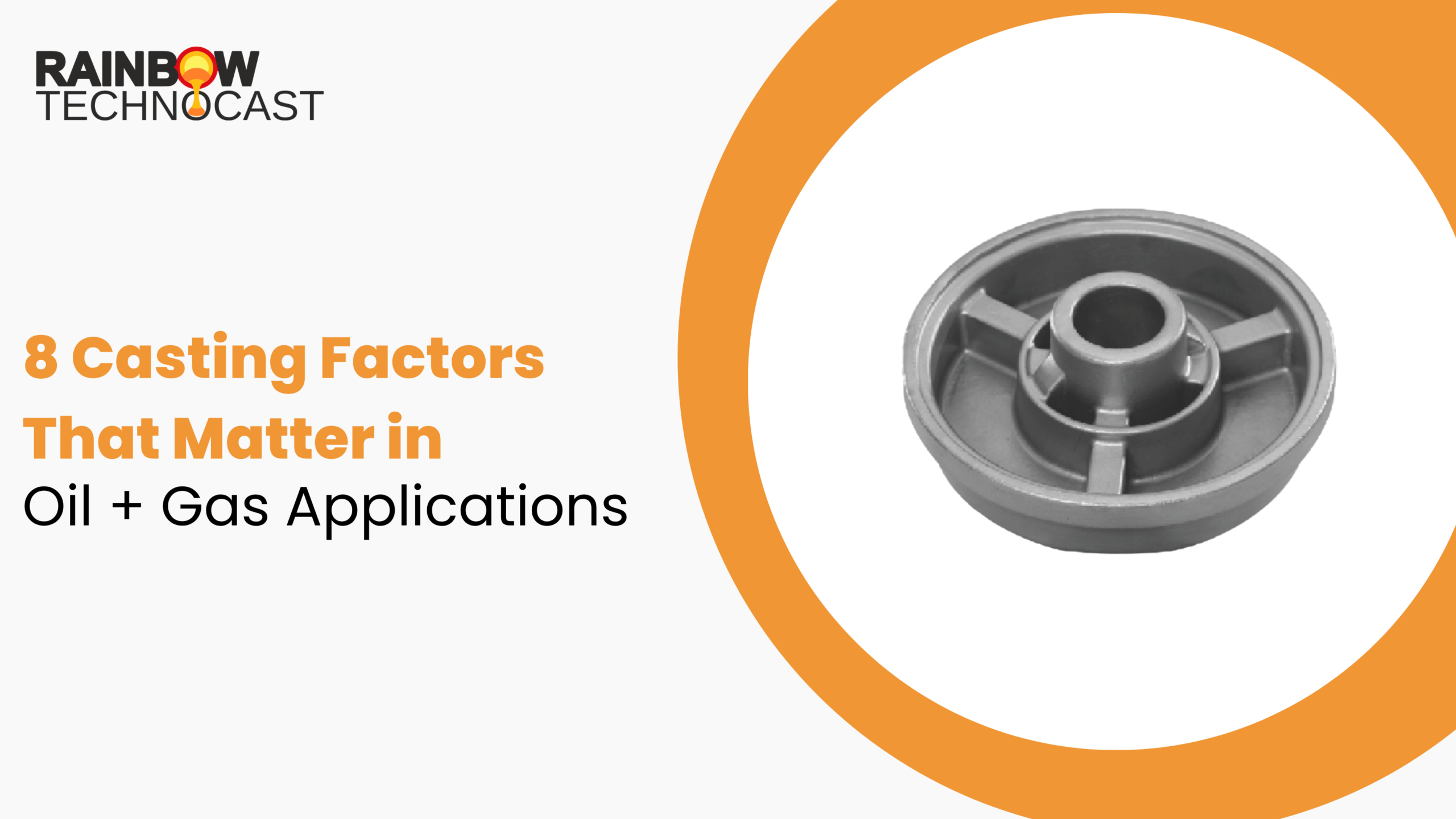
A cast valve body that leaks at 900 psi does not fail quietly. It shuts a line, triggers an incident report, and puts every part from that batch under review. Most of those failures trace back to decisions made long before the pour — a grade picked on price, an NDT scope trimmed to save two days, a drawing that ignored how metal actually solidifies. This piece breaks down the eight factors that decide whether an oil and gas casting holds up in service. We work with these variables every day at Rainbow Technocast. Read it as a buying checklist, not a metallurgy lecture.
Overview of Oil and Gas Casting Standards
General engineering castings get judged on fit and finish. Oil and gas castings get judged on what happens at the worst hour of their service life — full pressure, a temperature swing, a wet sour stream, and nobody nearby.
The Cost of One Failed Component
Here is the uncomfortable arithmetic. The casting is often the cheapest item in the assembly. The shutdown it causes is the most expensive. A pump casing might be a small line item on a purchase order, but the downtime it triggers gets measured in lakhs per hour on a live line.
That gap is why buyers in this sector behave differently from buyers in any other. They pay for margin they hope never to use.
What “Critical Service” Actually Means
“Critical service” is not a marketing phrase. In practice it means at least one of these is true:
- The part contains pressure
- Failure releases hydrocarbons or H2S
- The part sits somewhere you cannot reach without a shutdown
- A regulator or end client audits the paperwork behind it
If any box ticks, the eight factors below stop being preferences and start being requirements.
Key Casting Factors for Oil and Gas Equipment
1. Material Grade and Chemistry
Grade selection is where most problems begin, and it usually begins with a substitution nobody flagged.
Carbon steel grades like WCB handle general pressure duty at moderate temperature and cost the least. Low-temperature grades such as LCB and LCC hold impact toughness where the line runs cold. Austenitic stainless grades — CF8M and CF3M — take the corrosive and cryogenic work. Duplex and super duplex go where chlorides and strength demands meet.
Two things matter more than the grade name on the drawing:
- Chemistry within range, not just within spec. Two heats can both pass a spec and behave differently in service. Carbon at the top of the band changes weldability. Ferrite content in stainless changes corrosion behaviour.
- Who controls the substitution. If a foundry offers an “equivalent” grade, ask what property is equivalent and what property is not. There is almost always one of each.
2. Pressure and Temperature Rating
Pressure class is not a single number. It is a curve. An ASME class rating gives you a pressure that drops as temperature rises, and the same casting that is comfortable at ambient can be marginal at 400°C.
Ask three questions before you accept a rating:
- What is the design temperature, not the operating temperature?
- What happens during upset conditions and start-up?
- Does the wall thickness on the drawing match the class, or has it been optimised for weight?
Thin walls save metal and create hot spots that trap shrinkage. That leads straight to factor four.
3. Corrosion and Sour Service Resistance
Sour service — hydrogen sulphide in the stream — changes everything. Hardness limits get tighter. Heat treatment stops being optional. NACE MR0175 / ISO 15156 becomes the governing document, and compliance has to be demonstrated on the part, not asserted in a brochure.
Watch these specifically:
- Hardness caps. Sour service caps hardness because hard microstructures crack under sulphide stress. A part that machines beautifully may be too hard to be safe.
- Heat treatment records. Solution annealing for stainless, normalising and tempering for carbon steel — these need furnace charts, not a line on a certificate.
- Chloride exposure. Offshore and produced-water duty adds chlorides, and chlorides attack austenitic stainless at temperature. That is where duplex earns its price.
4. Internal Soundness and Porosity Control
A casting can pass every dimension and still be hollow where it matters. Shrinkage porosity forms in the last metal to freeze, which is usually the thickest section — and the thickest section is usually the flange or the seat area you needed most.
Soundness comes from method, not inspection. Gating and risering, chill placement, pour temperature, and mould rigidity decide whether the part is sound. Radiography only tells you afterwards.
Here is the pattern we see repeatedly: buyers negotiate hard on price, the foundry trims feeding aids to protect margin, and the rejection shows up at the customer’s machine shop three weeks later. The saving was never real.
5. Dimensional Accuracy and Machining Allowance
Investment casting holds tighter tolerances than sand casting, which is exactly why it dominates valve and instrumentation work. But tolerance is only half the story. The other half is allowance.
- Too little machining stock and a slightly shifted core exposes an unmachined face
- Too much stock and you pay twice — once in metal, once in cycle time
- Distortion after heat treatment catches people out on long, thin parts
The right conversation is about which surfaces are functional and which are cosmetic. Machining every face because the drawing says so is one of the quietest cost leaks in this industry.
6. Non-Destructive Testing Scope
NDT is where specifications get vague and disputes get expensive. “NDT as per standard” means nothing until you answer four questions:
- Which methods? Radiography, ultrasonic, magnetic particle, dye penetrant — each finds a different family of defect.
- Which zones? Full-body radiography on a complex casting is slow and often unnecessary. Critical zones — seat areas, flange faces, section changes — carry the risk.
- Which acceptance level? ASTM E446, E186, E280 severity levels change the answer completely.
- Who witnesses it? Third-party inspection adds days. Plan them into the schedule instead of arguing about them later.
7. Standards, Certification and Traceability
Paperwork is a deliverable in this sector, not an afterthought. A conforming casting with incomplete documentation is a non-conforming casting as far as the auditor is concerned.
The minimum set for critical service:
- Material test certificate tied to a heat number
- Heat treatment charts
- NDT reports with the operator’s qualification level
- Pressure or hydrostatic test record where applicable
- Full traceability from heat number to the mark on the part
Insist that the heat number is physically marked on the casting. Traceability that lives only in a file cabinet stops working the moment a part is unpacked.
8. Batch-to-Batch Repeatability
The first sample is easy. Any competent foundry can make one good part with enough attention. Repeatability across the twelfth batch, eighteen months later, on a different shift, is the actual test.
Repeatability comes from frozen process parameters: the same shell build, the same pour temperature window, the same tooling, the same heat treatment cycle. Ask a supplier what they have documented and locked. If the answer describes people rather than parameters, expect drift.
Key Engineering and Design Trade-offs
Trade-offs You Cannot Avoid
Every factor pulls against another, and pretending otherwise is how bad specs get written.
- Higher-alloy grades resist corrosion and cast harder — expect more feeding, more scrap, higher price
- Thinner walls cut weight and increase porosity risk
- Tighter tolerances cut machining and raise tooling cost
- Wider NDT scope catches more and stretches the lead time
Pick which two matter most for the application. Trying to maximise all four produces a quotation nobody wants to accept.
Where Buyers Usually Over-Specify
An honest observation from the quoting side: a meaningful share of premium specifications add cost without adding safety.
The common ones are full-body radiography on parts where the risk sits in two known zones, sour-service hardness limits on components that never touch the sour stream, and super duplex specified for temperatures where standard duplex has plenty of headroom. Each one is defensible in isolation. Together they inflate the price of an assembly and slow the delivery of every part in it.
Pre-Order Procurement Checklist
Run through this before the PO leaves your desk:
- Grade named, with substitutions explicitly disallowed or pre-approved
- Design temperature and pressure class both stated
- Sour service requirement confirmed either way, in writing
- NDT method, zone and acceptance level specified
- Machining allowance agreed surface by surface
- Documentation package listed as a deliverable
- Heat number marking location defined
- Lead time quoted with inspection days included
Eight lines. They prevent most of the disputes we see.
Frequently Asked Questions
Is investment casting always better than sand casting for oil and gas parts? No. Investment casting wins on tolerance, surface finish and complex internal geometry, which is why valve bodies and pump internals suit it. Very large or simple heavy sections are often better and cheaper in sand. The right question is which process suits the part’s size, complexity and finished tolerance — not which process is superior in general.
How much does material grade actually change the price of a casting? More than most buyers expect, and not linearly. Moving from carbon steel to austenitic stainless is a large step. Moving from stainless to super duplex or a nickel alloy is a larger one, because alloy cost, higher scrap rates and slower machining all stack. Get the grade right early — it drives the whole cost model.
Can porosity be repaired? Sometimes. Weld repair is permitted under many standards within defined limits, with qualified procedures and re-inspection afterward. Some specifications and some critical zones prohibit it outright. Agree the repair policy before production, not after a radiograph shows an indication.
What does NACE MR0175 compliance require from a foundry? Controlled chemistry, controlled heat treatment, hardness testing on the actual parts, and documentation proving all three. It is a process discipline, not a single test. Ask to see the hardness survey method and where on the part readings are taken.
How long should a critical casting order take? Tooling drives the first order — expect several weeks before the first article. Repeat orders run far faster. The variable people forget is third-party inspection and documentation review, which routinely adds a week. Build it into the schedule.
Summary
Get these eight factors settled before the pour and the rest of the project gets easier. Grade, rating, corrosion duty, soundness, tolerance, NDT, documentation, repeatability — decided on paper, verified in process, proven in the report.
Send us your drawing and service conditions. We will tell you which of the eight are actually driving your cost, and which you can relax without touching safety.
About Rainbow Technocast
Rainbow Technocast manufactures precision investment castings for critical service — including oil and gas, valve, pump and flow-control components — in stainless steel, alloy steel and carbon steel grades. Our promise is straightforward: castings that are sound where it matters, documented to the level your auditor expects, and repeatable batch after batch.
Send your drawing and service conditions for a technical review and quotation