
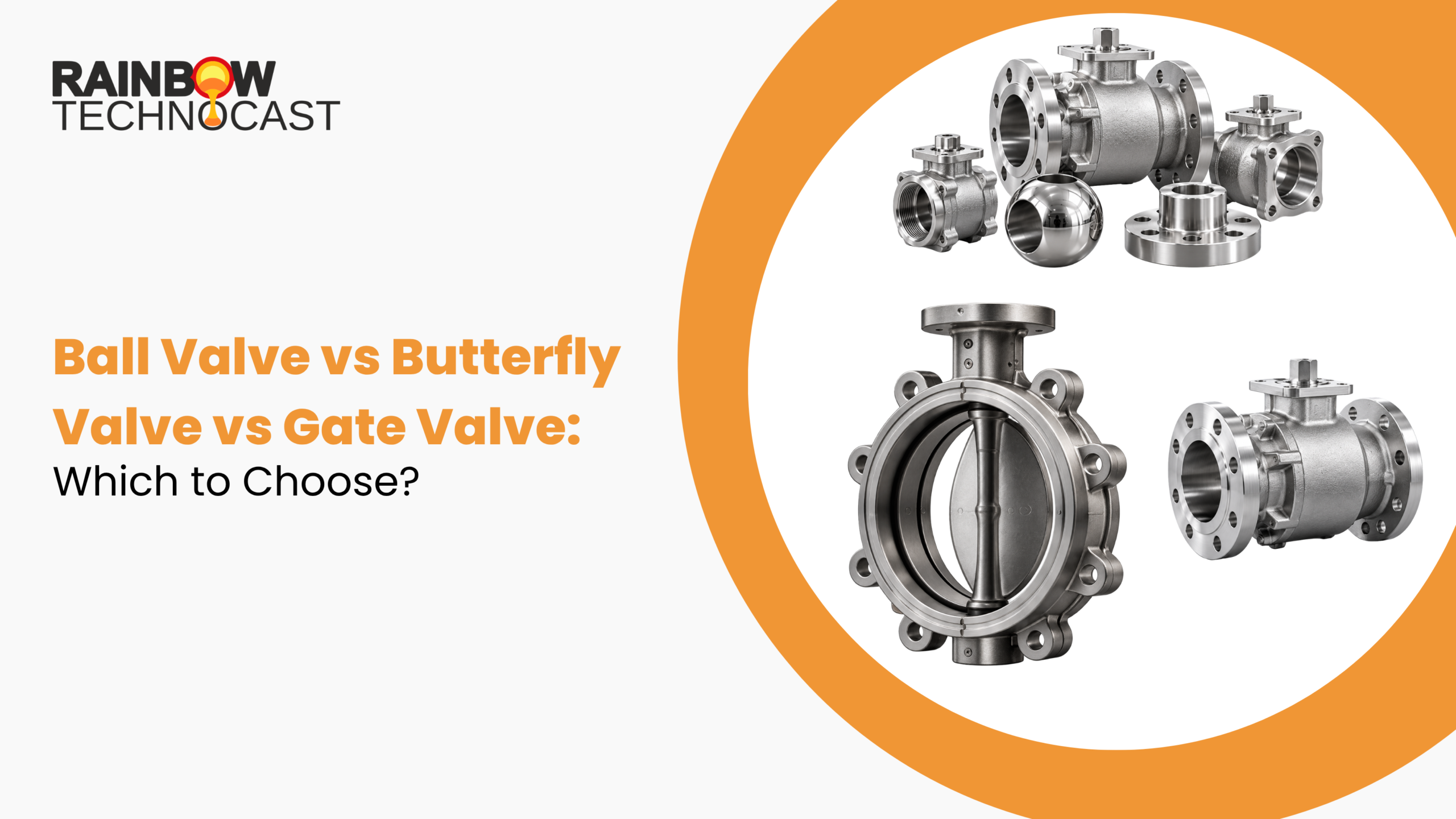
Three valves with the same nominal diameter can behave very differently in service. One offers a nearly clear flow path, another fits a restricted installation space, and another suits frequent quarter-turn operation.
Choosing between ball, butterfly, and gate valves means deciding which differences affect your system. This guide compares their working principles, shutoff behaviour, flow resistance, material requirements, and operating costs. It also explains what valve manufacturers should specify when sourcing cast components. The aim is a selection based on actual duty, with clear requirements for both the complete valve and the parts inside it.
Working Principles
Ball Valve
A ball valve rotates a bored ball through a quarter turn. When the bore aligns with the pipeline, fluid passes through; rotating the ball closes the passage.
Full-port designs provide a relatively unobstructed opening. Reduced-port designs use a smaller passage, so the words ball valve alone do not establish the available flow area.
Butterfly Valve
A butterfly valve rotates a disc within the flow passage. The disc opens through a quarter turn but remains in the fluid stream when the valve is fully open.
Its compact body can reduce installation length and weight, particularly in larger lines. Concentric, double-offset, and triple-offset designs have different sealing arrangements and service capabilities.
Gate Valve
A gate valve raises or lowers a gate across the passage. In a full-bore design, the gate withdraws from the main flow path when fully open.
Gate valves are commonly selected for isolation rather than regular flow adjustment.
Flow and Shutoff
Separate Isolation From Control
Isolation means opening or stopping flow. Control means adjusting flow over an operating range with acceptable stability and wear.
Standard ball and gate valves are generally selected for isolation. Butterfly valves can regulate flow in suitable applications, while specially designed control ball valves provide another option for modulation.
A valve that can sit partly open is not necessarily suitable for continuous throttling. Check the intended duty and the manufacturer’s sizing information.
Compare Flow Capacity
A fully open gate valve or full-port ball valve can offer low resistance. A butterfly disc remains in the passage, affecting flow even in the open position.
However, nominal diameter alone does not establish pressure loss. Compare the actual flow coefficient, required flow rate, fluid properties, and allowable pressure drop.
Define Leakage Requirements
No valve family guarantees a particular leakage performance by name. Seats, materials, differential pressure, temperature, wear, and the applicable test procedure all matter.
Specify permitted leakage and test conditions. Suitable butterfly valves can provide tight shutoff, so describing every butterfly valve as less leak-tight creates an inaccurate purchasing rule.
Pressure and Materials
Check the Complete Rating
Pressure capability belongs to the complete valve design. The body alloy, wall dimensions, connections, seats, seals, and temperature limits must work together.
Do not interpret a pressure-class number as an allowable pressure in every condition. Use the relevant pressure-temperature rating and the limitations of the selected construction.
Include All Wetted Parts
Body material is only part of chemical compatibility. The ball or disc, stem, seat, seals, and any coatings also contact the process fluid or its vapour.
Record:
- Fluid composition and concentration.
- Minimum, normal, and maximum temperature.
- Solids content and abrasive behaviour.
- Cleaning fluids and cleaning temperature.
- External exposure, including salt or washdown.
This information helps prevent a suitable metal body from being paired with an unsuitable sealing material.
Operation and Installation
Consider Operating Frequency
Ball and butterfly valves suit quarter-turn actuation, which can simplify repeated opening and closing. Gate valves normally require more travel and a different actuator arrangement.
Quarter-turn does not mean the valve should close as quickly as possible. In liquid systems, closure time can affect surge pressure and should suit the system design.
Check the Installation Space
A butterfly valve may save face-to-face space, but its disc needs clearance to rotate. Adjacent pipes, liners, reducers, or equipment can affect that clearance.
A rising-stem gate valve needs space above the valve for stem travel. Ball valves need access for the handle or actuator and for the maintenance method used by the selected body design.
Size the Actuator
The actuator must overcome the required torque or thrust under the specified conditions. Differential pressure, seat friction, service temperature, deposits, and operating frequency influence that demand.
Ask for the actuator selection basis rather than choosing only by connection size. Include the required position on loss of power or instrument air when the application needs a defined response.
Cost and Maintenance
Compare Installed Cost
Butterfly valves often offer an attractive weight and cost balance in large diameters. Ball valves can be attractive where frequent operation and suitable shutoff performance are priorities.
Gate valves may suit lines that stay fully open for long periods and need occasional isolation. These are starting points for comparison, not fixed price rankings.
Include:
- Valve and actuator purchase cost.
- Supports, access, and installation work.
- Pressure loss during normal operation.
- Replacement seats, seals, and service parts.
- Labour and shutdown time for maintenance.
Review Component Quality
For valve manufacturers, casting quality affects downstream assembly. Seat pockets, stem bores, flange faces, and body joints require controlled geometry and appropriate machining stock.
A pressure test on a casting does not establish the shutoff performance of an assembled valve. Shell integrity and seat leakage are separate acceptance questions.
Selection Guide
Start With the Duty
- Decide whether the valve must isolate, regulate, or perform both functions.
- Establish fluid, temperature, and pressure conditions.
- Calculate required flow capacity and acceptable pressure loss.
- Specify shutoff leakage, operating frequency, and actuation.
- Check installation, maintenance access, and connection details.
- Compare compliant valve configurations and supporting documents.
Apply the Comparison
For a frequently operated process isolation point, a suitable ball valve is a useful starting option. For a large cooling-water line with limited space, a butterfly valve may offer practical advantages.
For an infrequently operated isolation point needing a clear flow path, a suitable gate valve may fit. Confirm these choices against the fluid, rating, and actual design rather than treating an example as a specification.
Make Quotations Comparable
Ask suppliers to identify the proposed bore, seat material, pressure rating, and testing scope. Two valves described with the same size and body material can differ substantially in these details.
For automated valves, include actuator accessories and operating requirements in the enquiry. Otherwise, a lower quotation may simply cover less equipment.
FAQs
Which Valve Is Best for Throttling?
A suitably sized butterfly valve can handle some control duties. A control ball valve may also work, but ordinary isolation ball valves and gate valves should not be assumed suitable for continuous regulation.
Is a Butterfly Valve Suitable for High Temperature?
Some designs are, including appropriate metal-seated constructions. The exact body, seat, seal, and pressure-temperature limits determine suitability.
Can One Valve Type Replace Another Directly?
Not automatically, even at the same nominal size. Check face-to-face dimensions, connections, flow capacity, actuation, pressure rating, and maintenance access before approving a replacement.
Conclusion
Choose a ball, butterfly, or gate valve around its required function and operating conditions. Then compare the specific construction, flow capacity, shutoff requirement, and installation costs. Prepare a valve specification with these details before requesting quotations.
Rainbow Technocast
Rainbow Technocast manufactures ball valve castings and butterfly valve castings for industrial applications. Its casting capabilities support the component geometry that valve assemblies require.
Send your valve-component drawings and material specifications to Rainbow Technocast to discuss your casting requirements.