
Introduction
Camlock fittings look simple: two halves, two levers, one quick connection. Yet wrong orders are common. A buyer receives a Type A when the hose needed a Type C, or an aluminium fitting goes onto an acid line and corrodes within weeks.
Most of these mistakes come from three things: confusing the letter types, mixing up size and thread standards, and choosing the wrong body or gasket material. This guide sorts all three out. It explains how camlock fittings work, the standards behind them, each type from A to F plus dust caps and plugs, how to measure sizes, how to choose materials and gaskets, and how to select the right fitting for the job.
What Are Camlock Fittings?
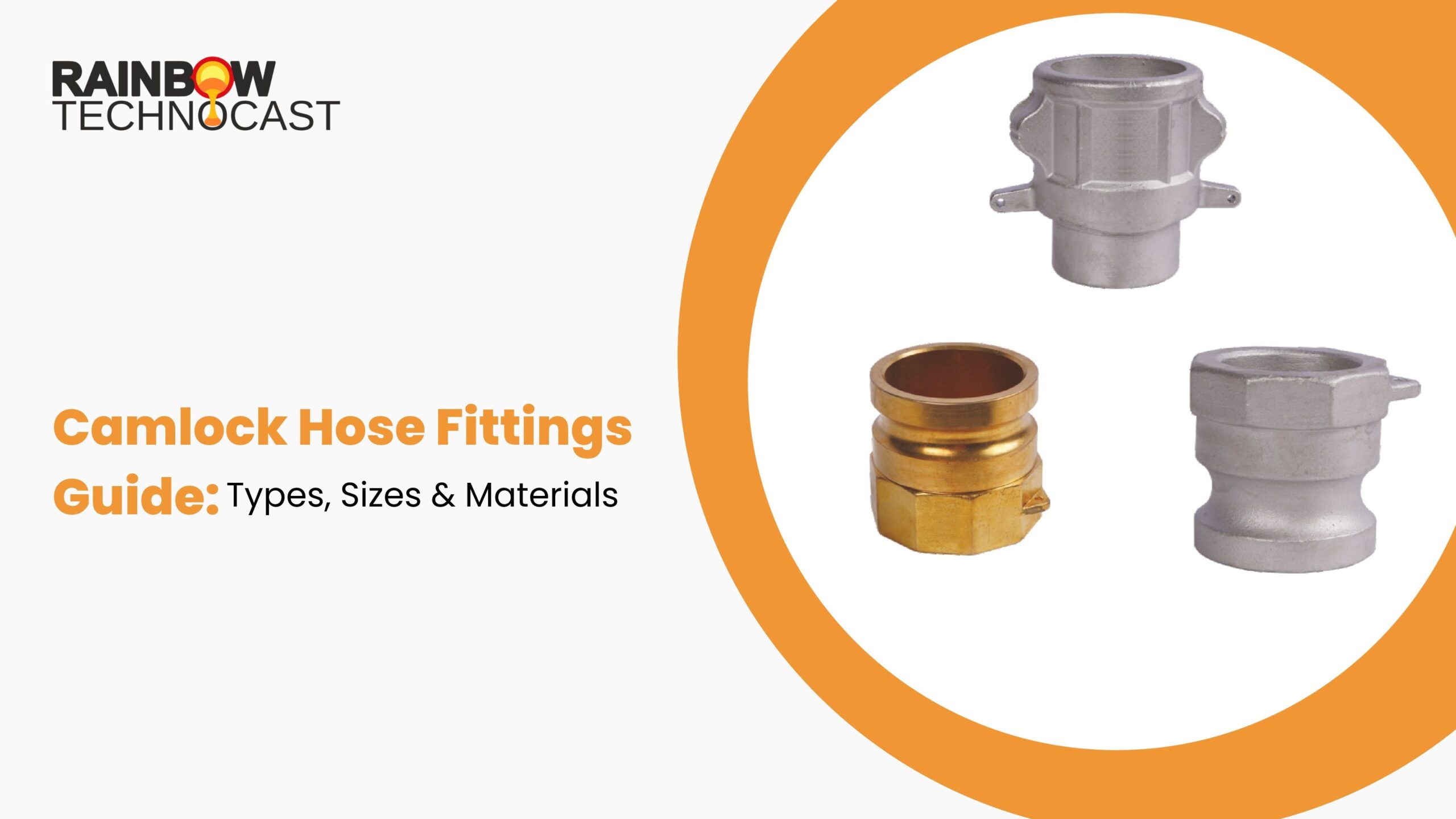
Camlock fittings, also called cam and groove couplings, are quick-connect fittings used to join hoses to other hoses, pipes, pumps and tanks without tools.
How Camlock Fittings Work
A camlock connection has two halves:
- Male adapter – has a machined groove around its outer surface
- Female coupler – has two cam arms (levers) and a gasket inside
The male adapter slides into the female coupler. When the cam arms are pulled down, their cams press into the groove, pull the two halves together and compress the gasket. This creates a leak-tight seal. Lifting the arms releases the connection.
Why Use Camlock Fittings
- Fast connection and disconnection without tools
- Interchangeable between suppliers when made to the same standard
- Suitable for frequent hose changes
- Wide choice of sizes and materials
- Simple design with few moving parts
Camlock Fitting Standards
Camlock dimensions are governed by standards so that fittings from different makers can mate together.
- A-A-59326 – the US commercial item description that replaced the older military specification MIL-C-27487
- EN 14420-7 – the European standard for cam-lever couplings (earlier DIN 2828)
Fittings made to the same standard are generally interchangeable. However, the 1/2-inch and 8-inch sizes are not always covered, so these sizes may not interchange between makers. Always confirm the standard before mixing sources.
Camlock Fitting Types
Each type combines one camlock end (male adapter or female coupler) with one connection end (thread or hose shank).
Type A
Male adapter × female thread. Screws onto a male-threaded pipe or tank outlet to provide a male camlock connection.
Type B
Female coupler × male thread. Screws into a female-threaded port, giving a female camlock connection on equipment.
Type C
Female coupler × hose shank. Fits inside a hose and is clamped in place. It is one of the most widely used types on hose ends.
Type D
Female coupler × female thread. Screws onto male-threaded pipe or equipment to give a female camlock end.
Type E
Male adapter × hose shank. Fits into a hose to give a male camlock connection. Type C and Type E together form a common hose-to-hose pair.
Type F
Male adapter × male thread. Screws into a female-threaded port to give a male camlock end.
Type DC (Dust Cap)
A female cap that fits over a male adapter (Types A, E or F). It seals and protects the adapter when not in use.
Type DP (Dust Plug)
A male plug that fits into a female coupler (Types B, C or D). It seals the coupler and keeps dirt out.
Camlock Type Chart and Mating Combinations
| Type | Camlock end | Connection end | Mates with |
| A | Male adapter | Female thread | B, C, D, DC |
| B | Female coupler | Male thread | A, E, F, DP |
| C | Female coupler | Hose shank | A, E, F, DP |
| D | Female coupler | Female thread | A, E, F, DP |
| E | Male adapter | Hose shank | B, C, D, DC |
| F | Male adapter | Male thread | B, C, D, DC |
| DC | Cap | — | A, E, F |
| DP | Plug | — | B, C, D |
An easy way to remember: any male adapter (A, E, F) mates with any female coupler (B, C, D) of the same size.
Camlock Fitting Sizes
Standard Size Range
Common sizes run from 1/2 inch to 6 inches, with 8 inch available in some ranges. The most widely used sizes in industry are 1, 1-1/2, 2, 3 and 4 inches.
How to Measure a Camlock Fitting
Camlock sizes are nominal sizes, not exact dimensions.
- Male adapter – measure the outside diameter of the grooved end
- Female coupler – measure the inside diameter of the coupler opening
- Hose shank – match to the hose inner diameter
Then compare the measurement against a size chart for the relevant standard.
Thread Types (BSP vs. NPT)
Threaded camlock types (A, B, D, F) come with either BSP (British Standard Pipe) or NPT (National Pipe Taper) threads. The two look similar but are not compatible. BSP is common in India, Europe and Australia, while NPT is common in North America. Mixing them causes leaks and damaged threads.
Camlock Fitting Materials
Stainless Steel
Usually grade 316 (cast equivalent CF8M), sometimes 304 (CF8). Stainless fittings are typically made by investment casting, which gives accurate cam grooves and smooth surfaces.
Best for: chemicals, food and beverage, pharmaceuticals, solvents and corrosive service.
Aluminium
Light and economical. Good for water, oils and fuels.
Avoid with: strong acids and alkalis, which corrode aluminium.
Brass
Good corrosion resistance and durability. Common in fuel, petroleum and marine service.
Polypropylene and Nylon
Light, low-cost and resistant to many chemicals. Pressure and temperature ratings are lower than metal fittings.
Material Comparison Table
| Material | Corrosion resistance | Strength | Weight | Typical use |
| Stainless steel 316 | Excellent | High | Heavy | Chemicals, food, pharma |
| Aluminium | Moderate | Good | Light | Water, oil, fuel |
| Brass | Good | Good | Heavy | Fuel, marine, petroleum |
| Polypropylene | Good (chemical) | Lower | Very light | Agriculture, dilute chemicals |
Here is a point many buyers miss. Mixing materials can shorten service life. Aluminium paired with stainless in a wet, conductive fluid can suffer galvanic corrosion, and some suppliers advise against mixing plastic and aluminium fittings. Keep both halves of a connection in compatible materials.
Gaskets and Seal Materials
The gasket often decides chemical and temperature compatibility, not the body.
- NBR (Buna-N) – oils, fuels and water; the most common default
- EPDM – water, steam condensate, many acids and alkalis; not for oils
- FKM (Viton) – fuels, solvents and many aggressive chemicals; higher temperatures
- PTFE or PTFE-encapsulated – the widest chemical resistance
Check the gasket against the fluid using a chemical compatibility chart before ordering.
Pressure and Temperature Ratings
Ratings vary by size, material and manufacturer. As a general pattern, pressure ratings fall as size increases. Some stainless steel ranges, for example, are rated at around 200 psi for smaller sizes, dropping to around 100 psi at 5 to 6 inches.
Temperature limits are set mainly by the gasket. Camlock fittings are designed for liquid and dry-bulk transfer, and most makers state they must not be used for compressed air or steam service.
How to Choose the Right Camlock Fitting
- Identify both ends. What are you connecting: hose, pipe, pump or tank?
- Choose the gender. Decide which side needs the male adapter and which the female coupler.
- Pick the type. Use the type chart to match thread or hose shank.
- Confirm size and thread. Measure, and check BSP or NPT.
- Select body material. Match it to the fluid, environment and pressure.
- Select gasket material. Check chemical and temperature compatibility.
- Check pressure rating. Confirm it meets system pressure with a safety margin.
- Verify the standard. Ensure both halves are made to the same dimensional standard.
Common Applications
- Chemical and petrochemical transfer
- Tanker loading and unloading
- Food, beverage and dairy processing
- Agriculture and irrigation
- Construction dewatering
- Mining and slurry handling
- Fire fighting water supply
- Pharmaceutical manufacturing
Safety and Maintenance Tips
- Depressurise and drain lines before disconnecting
- Inspect gaskets regularly and replace if cracked, swollen or flattened
- Check cam arms and pins for wear or bending
- Use locking cam arms where accidental opening is a risk
- Never use camlocks for compressed air or steam
- Keep caps and plugs on open ends to keep dirt out of the seal area
FAQs
What is the difference between Type A and Type B camlock fittings?
Type A is a male adapter with a female thread. Type B is a female coupler with a male thread. They are opposites in both camlock end and thread gender.
Which camlock types are used on hose ends?
Type C (female coupler) and Type E (male adapter) have hose shanks. They are the standard choices for hose ends and are often used together.
Are camlock fittings from different suppliers interchangeable?
Generally yes, if both are made to the same standard such as A-A-59326 or EN 14420-7. Some sizes, like 1/2 inch and 8 inch, may not interchange.
Can camlock fittings be used for compressed air?
No. Most manufacturers state camlock fittings should not be used for compressed air or steam because a sudden release under pressure can be dangerous.
Which material is best for chemical service?
Stainless steel 316 is the most common choice for chemicals, paired with a gasket such as FKM or PTFE. Always confirm compatibility with the specific chemical.
Conclusion
The right camlock fitting comes down to four checks: the correct type for each end, the correct size and thread, a body material suited to the fluid and a gasket that can handle it. Get these right and the connection will be quick, safe and leak-tight.
Before your next order, list the type, size, thread, body material and gasket for each connection on one sheet and verify it against the charts above.
About Rainbow Technocast
Rainbow Technocast manufactures cam and groove fitting castings for fitting manufacturers and OEMs from Shapar, Rajkot. We investment cast camlock bodies, couplers, adapters, caps and plugs in stainless steel grades such as CF8M and CF8, along with other alloys to customer specification.
Investment casting gives accurate cam grooves, consistent wall thickness and smooth surfaces that seal well and reduce machining. With three foundries, two machining shops and more than 20 years of experience, we verify every melt by spectrometer and inspect parts dimensionally, with DPI and pressure testing as specified.
Our promise: dimensionally consistent camlock castings that mate cleanly and seal reliably, batch after batch.
Send your camlock fitting drawings or size range through our contact page for a quotation.