
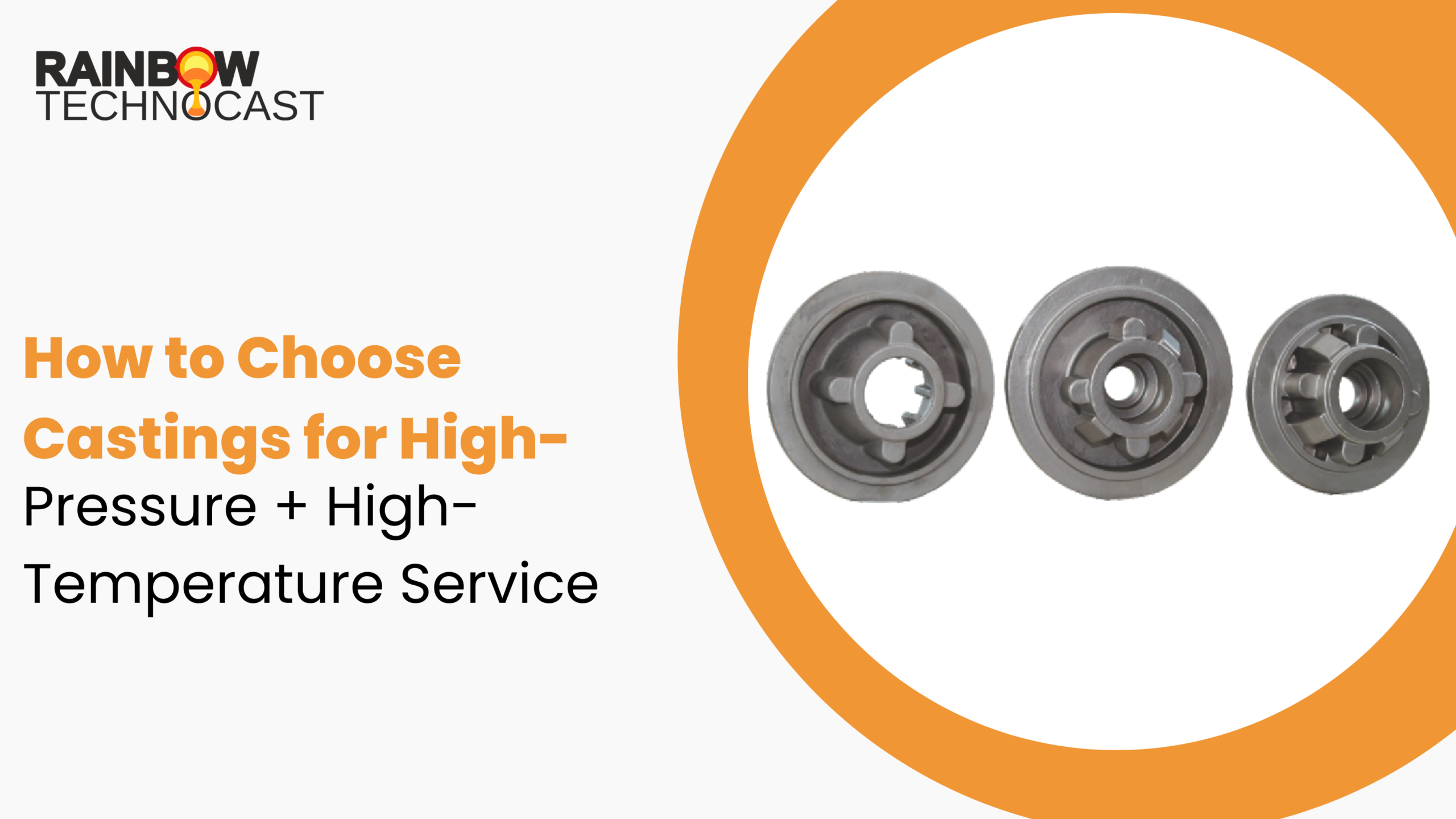
Most HPHT casting problems are not metallurgy problems. They are specification problems. Someone lists a peak pressure, someone else lists a peak temperature, and nobody checks whether the material holds both at the same moment. The part then survives the hydrotest and cracks after two hundred thermal cycles. This guide gives you a working sequence — define the envelope, shortlist the family, check the derating, fix the sections, lock the heat treatment, set the testing, price the escalation. We build these parts at Rainbow Technocast, and the sequence below is how we get quotes right the first time.
What is High Pressure and High Temperature Service?
There is no single threshold. In practice, a casting enters HPHT territory when either the pressure rating stops being comfortable at the design temperature, or the temperature is high enough that the material’s strength is time-dependent rather than fixed.
Pressure and Temperature Work Together
This is the point people miss. Pressure containment depends on material strength. Material strength falls as temperature rises. So the pressure a casting can hold is a function of how hot it is at that moment.
An ASME class rating already accounts for this — the allowable pressure drops down a curve as temperature climbs. What the class rating does not do is tell you whether your specific part, with its specific wall thickness and its specific soundness, sits on that curve or below it.
Steady Heat vs. Thermal Cycling
Treat these as two different design problems.
- Steady high temperature attacks through creep — slow deformation under load over thousands of hours. It rewards creep-resistant chemistry and stable microstructure.
- Thermal cycling attacks through fatigue — expansion and contraction working a stress concentration until it cracks. It rewards generous radii, uniform sections and ductility.
A material that is excellent at one can be mediocre at the other. Start-stop service is harder on a casting than continuous hot service at the same peak temperature, and it is routinely under-specified.
Step 1: Define Your Service Requirements
Before any material discussion, write down six numbers:
- Design pressure and design temperature (not operating — design)
- Maximum coincident pressure and temperature, together
- Upset or excursion conditions and their duration
- Expected number of thermal cycles over the service life
- Media composition, including H2S, chlorides and moisture
- Required service life in hours
If you cannot fill all six, the gaps are where the risk is hiding. A foundry cannot fill them for you, and a supplier who quotes without them is guessing.
Step 2: Choose the Right Material
Carbon and Low-Alloy Steels
Grades like WCB and WCC handle pressure duty well up to moderate temperature and cost the least. Above roughly 425°C, carbon steel begins to lose strength quickly and graphitisation becomes a concern in long-term service. They are the right answer far more often than premium suppliers admit — but not for sustained heat.
Chrome-Moly Grades
This is the workhorse family for hot pressure service. WC6 and WC9 add chromium and molybdenum for creep strength and elevated-temperature stability. C5 and C12A push further up in temperature and add oxidation resistance.
Chrome-moly grades demand discipline. They need controlled preheat during any welding, defined post-weld heat treatment, and careful cooling. Foundries that treat them like carbon steel produce parts that crack.
Austenitic Stainless Steels
CF8M and CF3M bring corrosion resistance and hold useful strength at high temperature. Two cautions:
- Thermal expansion is significantly higher than carbon steel, which matters at flanged joints and in mixed-material assemblies
- Sustained exposure in the sensitisation range can degrade intergranular corrosion resistance — low-carbon or stabilised grades address this
Duplex and Nickel Alloys
Duplex offers high strength and chloride resistance, but has an upper temperature ceiling — hold it below the range where its ferrite phase embrittles. Nickel alloys go where nothing else survives: extreme temperature, extreme corrosion, or both.
Nickel alloys are also the point where cost stops being a line item and becomes the project. Escalate to them deliberately, with a reason you can write down.
Step 3: Check Pressure and Temperature Ratings
Take your shortlisted grade and the applicable pressure-temperature rating table. Find your design temperature. Read the allowable pressure. Compare it to your design pressure with the margin your standard requires.
Do this before the drawing is finalised, not after. Two things go wrong when it is done late:
- The class has to be raised, which thickens every wall and changes the tooling
- The grade has to be escalated, which changes the price by a multiple, not a percentage
The five minutes this step takes routinely saves a tooling revision.
Step 4: Design Wall Thickness Correctly
Thick walls hold pressure. Thick walls also solidify last, and metal that solidifies last shrinks with nowhere to draw from. That is porosity, sitting precisely in the region carrying the highest hoop stress.
Design rules that help:
- Keep wall thickness as uniform as the function allows
- Taper transitions rather than stepping them
- Use generous fillets at every section change — sharp internal corners are both hot spots during solidification and stress raisers in service
- Where a heavy boss is unavoidable, tell the foundry early so it can be chilled or fed properly
An observation worth internalising: on hot pressure parts, uniform sections do more for reliability than a grade upgrade. Buyers reach for the alloy because it is a purchasing decision. Section design is an engineering decision, and it is usually the cheaper fix.
Step 5: Verify Heat Treatment
For HPHT service, heat treatment is not a finishing step. It is what creates the properties the design assumed.
- Carbon and low-alloy castings: normalise and temper, or quench and temper, to the specified condition
- Chrome-moly grades: austenitise, then temper within a tight window — the tempering temperature sets creep strength and hardness together
- Austenitic stainless: solution anneal and quench, to put carbides back into solution
Ask for furnace charts with the delivery. A certificate saying “normalised and tempered” is a claim. A chart showing soak time and temperature is evidence.
Step 6: Plan Testing and Inspection
Define what will be tested, where, and to what acceptance level:
- Radiography on critical zones — section changes, flange necks, seat regions
- Ultrasonic on heavy sections where radiography loses sensitivity
- Magnetic particle or dye penetrant on all machined sealing surfaces
- Mechanical testing at temperature if the design relies on hot properties
- Hydrostatic test at the rated multiple of working pressure
- Impact testing where low-temperature excursions are credible
Name severity levels explicitly. “Radiography per ASTM E446” without a level is an argument waiting to happen.
Step 7: Understand Material Costs
Each step up the material ladder carries a cost stack, and the alloy premium is only the visible part.
- Alloy cost rises
- Melting and pouring gets more demanding, so scrap rates rise
- Machining gets slower and tooling wears faster
- Heat treatment windows narrow, so rework rises
- Lead time extends
By the time you reach nickel alloys, the finished-part cost can be several times the carbon steel equivalent. That is fine when the service demands it. It is waste when the escalation happened because nobody checked the derating curve at step three.
Common Casting Failure Modes
Creep and Stress Relaxation
Above the creep threshold, the material deforms slowly under constant load. Bolted flanges lose preload. Clearances close. The part does not break — it drifts out of function. Design to a time-dependent allowable stress, not a room-temperature yield.
Thermal Fatigue Cracking
Every start-up and shutdown works the part. Cracks initiate at the sharpest internal corner, the thickest-to-thinnest transition, or a surface defect left by a repair weld. Radii and surface quality are the defence.
Bolted Joint Relaxation
Mixed-material assemblies expand at different rates. A stainless casting bolted to a carbon steel flange with carbon steel studs will not stay tight through a wide temperature swing unless the joint was designed for it. This shows up as a leak that appears only when hot, and it gets blamed on the casting.
Frequently Asked Questions
Can I use CF8M for high-temperature service instead of chrome-moly? Sometimes, and it depends what you need. CF8M brings corrosion resistance and holds reasonable strength hot. Chrome-moly grades are specifically formulated for creep strength in long-term hot pressure service and cost less. If corrosion is the driver, stainless. If sustained temperature under pressure is the driver, chrome-moly usually wins on both performance and price.
How does wall thickness affect pressure rating? Directly — hoop stress scales with pressure and diameter and falls with wall thickness. But thicker is not automatically safer in a casting, because heavy sections invite shrinkage porosity. The useful target is adequate thickness with uniform sections and verified soundness, not maximum thickness.
Do I need impact testing if the part runs hot? Possibly. Parts that run hot still get commissioned cold, hydrotested cold, and shut down in winter. If any credible condition puts the material below its transition temperature under load, specify impact testing. Ignoring it because “it’s a hot service part” is a common and avoidable gap.
What documentation should come with an HPHT casting? Material test certificate against heat number, full chemistry and mechanical results, heat treatment charts, NDT reports with operator qualification, hydrostatic test record, and traceability marking on the part itself. For creep-range service, add elevated-temperature test data if the design depends on it.
How early should the foundry be involved? At the drawing stage, before geometry is frozen. Most of what makes a casting sound — section uniformity, radii, feeding paths, parting line placement — is cheap to change on a drawing and expensive to change in tooling.
Summary
Work the sequence in order. Define the envelope, shortlist the family, check the derating, fix the sections, lock the heat treatment, set the testing, price the escalation. Skip a step and you find out which one you skipped somewhere around cycle two hundred.
Send us your service envelope — the six numbers from step one. We will come back with a grade recommendation, a soundness plan for the critical zones, and a quotation you can rely on.
About Rainbow Technocast
Rainbow Technocast produces precision investment castings for high-pressure and high-temperature service in carbon steel, alloy steel and stainless steel grades. Our promise: sound castings where the stress actually is, heat treatment you can verify from the charts, and documentation that survives an audit.
Share your drawing and service conditions for a technical review and quotation.