
Introduction
Most pump failures don’t start with the impeller or the seal — they start at the foundry, months or years before the pump ever touches fluid. A casing with a hidden shrinkage void, a material grade that can’t handle the actual chloride content in the process water, or a rough internal volute that quietly bleeds efficiency — these are foundry-stage decisions that show up as field problems later.
Pump casting isn’t a generic manufacturing step. It’s a set of interconnected decisions — material, process, wall geometry, and testing protocol — that together determine whether a pump runs for fifteen years or fails in eighteen months. Get the material wrong for the fluid chemistry, and corrosion eats through the casing early. Get the internal flow path wrong, and cavitation erodes the volute before its time.
This guide covers the materials that matter for pump castings, the applications that drive material selection, the casting processes available, and the design and quality considerations that separate a pump body built to last from one that’s built to a price point.
What Pump Casting Actually Involves
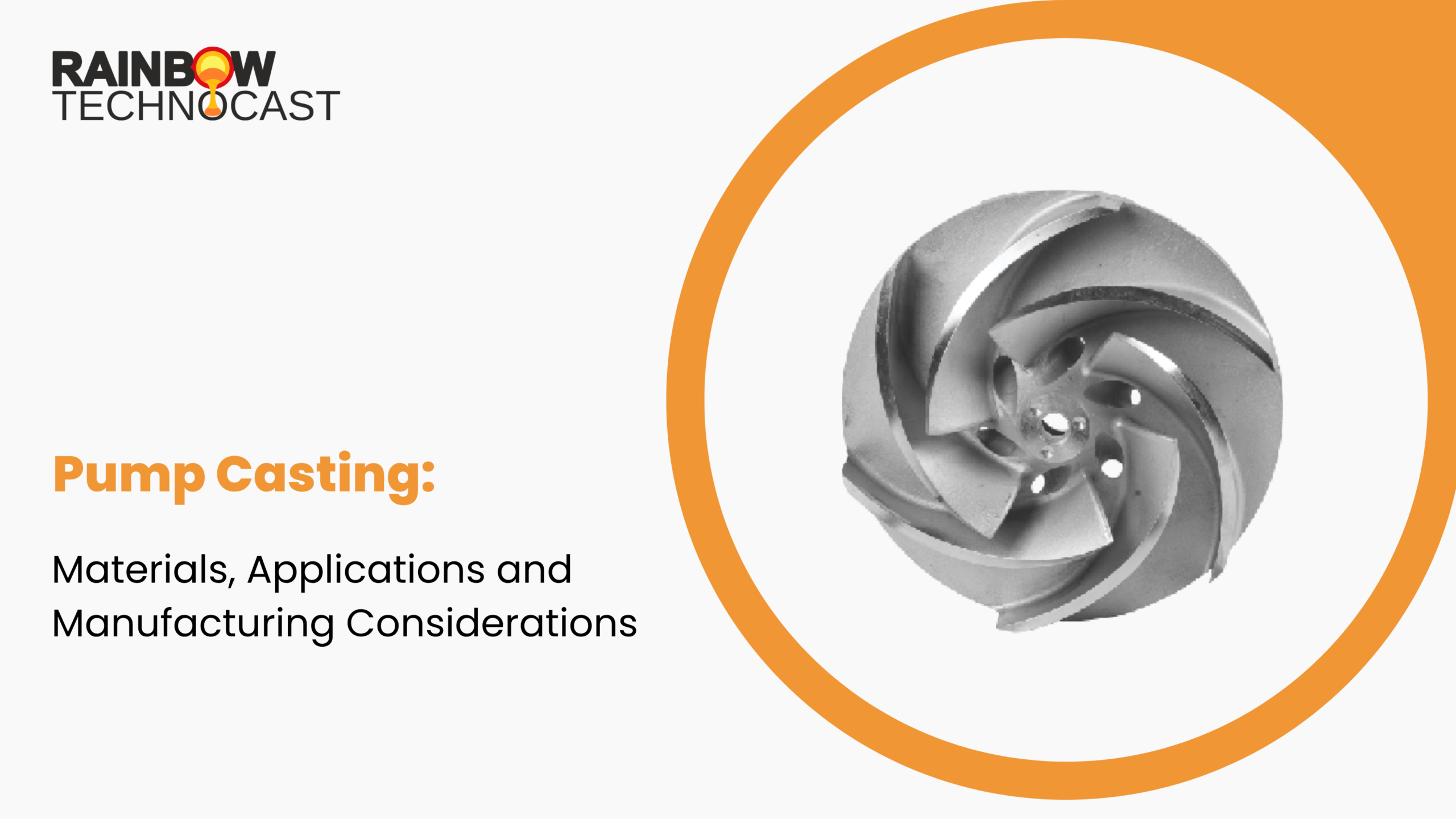
A pump casting produces the components that contain and direct fluid under pressure — housings, volutes, impellers, covers, and bearing brackets. These parts need to be leak-tight, dimensionally accurate at critical interfaces, and structurally sound under cyclic pressure loading.
Casting is preferred over fabrication or full machining for one specific reason: pump bodies have complex internal geometry — curved volutes, flow passages, and cored cavities — that would be prohibitively expensive or physically impossible to machine from solid billet. The casting process forms this complexity directly into the part.
Common Pump Casting Materials
Material selection is the single decision with the highest lifecycle impact. Choose wrong, and no amount of good machining or testing saves the part from premature failure.
Carbon Steel
Grades like WCB and WCC handle general-purpose water, oil, and non-corrosive fluid service. They’re the default choice when the media doesn’t demand corrosion resistance beyond standard atmospheric exposure.
Stainless Steels
304, 316/316L, CF8, and CF8M grades dominate corrosive and chloride-rich environments. CF8M in particular is the standard specification for chemical processing pumps handling moderate chloride concentrations.
Duplex and Super Duplex Stainless Steels
Grades 2205 and 2507 step up resistance for seawater, offshore, and aggressive chemical applications where standard austenitic stainless corrodes too quickly. These alloys cost more but eliminate the repeat-replacement cycle that undersized material grades create.
Cast Iron and Ductile Iron
Reliable, cost-effective choices for low-to-medium pressure clean water and HVAC circulation pumps — applications where corrosion resistance requirements are modest.
Nickel-Based and Cobalt Alloys
Inconel and Hastelloy handle extreme corrosion and high-temperature service. Cobalt-base alloys like Stellite address severe erosion and wear — often applied as hardfacing rather than the full casting.
Bronze and Aluminum Bronze
Marine and seawater pumps rely on bronze alloys for their anti-galling properties and natural resistance to biofouling — a practical advantage in continuous seawater immersion that stainless steel doesn’t match as effectively.
Pump Types and Their Application Demands
Different pump categories place different demands on the casting, and material choice follows directly from application.
Centrifugal Pumps
Volutes, casings, and impellers for water treatment, general industrial fluid transfer, and fire protection systems typically use carbon steel or stainless grades depending on fluid corrosivity.
Submersible and Sewage Pumps
Corrosion resistance combines with abrasion tolerance here — wastewater and slurry service wear down softer materials fast, pushing specification toward ductile iron or hardened stainless grades.
Chemical Process and Dosing Pumps
High-alloy stainless and nickel-based castings handle the aggressive, often unpredictable chemistry found in process plants — a lower-grade substitution here creates rapid, expensive failure.
Vacuum, Hydraulic, and Offshore Pumps
These applications need precision-cast bodies with tight tolerances and complex internal passages — investment casting is the near-universal process choice for this category.
Casting Processes for Pump Components
The right process depends on part size, geometry complexity, material, and production volume.
Sand Casting
Cost-effective for large casings where dimensional precision requirements are moderate. Works well in iron and carbon steel grades and remains the default for bigger, simpler pump housings.
Investment Casting
The preferred process for complex geometries, thin walls, and smooth internal flow paths — particularly in stainless and high-alloy materials. Investment casting delivers as-cast surface finish fine enough to reduce hydraulic friction losses inside the volute.
Die Casting and Permanent Mold Casting
Suited to aluminum pump housings in lightweight, low-pressure applications where weight matters more than extreme pressure tolerance.
Rapid or 3D-Printed Sand Casting
A tooling-free option that has changed the economics of small-batch and prototype pump castings. Complex internal volutes and passages that would demand expensive hard tooling can now be produced from a printed mold in days rather than weeks.
Material Selection Factors
Choosing the right grade requires working through four variables systematically:
- Fluid chemistry — pH, chloride content, dissolved gases, and particulate load all drive corrosion resistance requirements
- Pressure class and temperature — ANSI pressure class ratings and thermal cycling determine required wall thickness and material strength
- Erosion and abrasion exposure — slurry, sand, or solids content may require hardfacing or cobalt-base alloy protection on wear surfaces
- Regulatory and containment requirements — hazardous media handling introduces specific compliance and material traceability obligations
A genuinely useful — and uncomfortable — pattern worth noting: most pump casing failures attributed to “material fatigue” in post-incident reports are actually material grade mismatches identified too late, after the pump had already been running in service conditions the original specification never accounted for.
Design Considerations That Determine Performance
Internal Flow Paths
Smooth volutes, generous fillet radii, and controlled flow convergence reduce turbulence and cavitation — both of which erode pump efficiency and shorten component life. This is a design decision made at the casting stage, not something machining can fix afterward.
Wall Thickness Consistency
Uniform wall sections avoid hot spots during cooling, which prevents shrinkage defects and reduces stress concentration points that later become fatigue crack initiation sites.
Gating and Riser Design
Optimized feed systems, frequently designed using solidification simulation software, prevent porosity and shrinkage cavities before the first casting is even poured.
Dimensional Accuracy
Investment-cast pump bodies routinely achieve ISO 8062 CT4–CT6 tolerance grades — tight enough for leak-tight fits with minimal secondary machining required.
Surface Finish
As-cast surface roughness of Ra 1.6–3.2 μm on investment-cast internal surfaces directly reduces friction losses, which translates into measurable energy savings over the pump’s operating life.
Quality Assurance and Testing
A pump casting’s quality claims mean nothing without verified testing behind them:
- Non-destructive testing (NDT) — ultrasonic and radiographic inspection for internal defects, dye penetrant for surface cracks
- Hydrostatic and pressure testing — verifies casing integrity and leak-tightness at the rated pressure class
- Chemical and mechanical verification — spectrometer alloy analysis and tensile/impact testing, tied to a mill test report for full traceability
- Dimensional inspection — CMM checks on critical interfaces, seal housings, and bearing bores where fit tolerance matters most
Cost and Volume Trade-Offs
The casting-versus-machining decision for pump bodies follows a predictable pattern: casting becomes progressively more cost-effective as geometry complexity and annual volume increase — often becoming the clear winner somewhere between 500 and several thousand pieces annually, depending on complexity.
Traditional hard tooling suits stable, high-volume production runs. Rapid casting and printed molds support fast iteration and lower-volume orders without the upfront tooling investment that used to make small batches impractical for casting.
The lifecycle math matters more than the unit price. Material and casting quality reduce maintenance frequency, unplanned downtime, and replacement cycles — costs that dwarf the initial casting price difference between a properly specified alloy and a cheaper substitute.
FAQs
What’s the most common material mistake in pump casing selection?
Specifying standard 316 stainless steel for applications with high chloride concentration or elevated temperature, where duplex or super duplex grades are actually required. 316 stainless resists moderate chlorides well, but pitting and stress corrosion cracking accelerate sharply once chloride levels or temperatures exceed its practical limits.
Does investment casting always cost more than sand casting for pump bodies?
Not necessarily once you factor in machining. Investment casting’s near-net-shape accuracy and superior surface finish reduce downstream machining time significantly, which can offset its higher per-unit casting cost — particularly for complex internal geometries where sand-cast parts would need extensive secondary work.
How much does internal surface finish actually affect pump efficiency?
More than most specifications account for. Rougher internal surfaces increase hydraulic friction losses, which translates directly into higher energy consumption over the pump’s operating life. Investment-cast volutes with smooth as-cast finish measurably outperform rough sand-cast equivalents in efficiency testing, especially at higher flow rates.
Can a pump casing be repaired if it develops a defect after machining?
It depends on defect location and severity. Minor surface flaws away from pressure-retaining or seal-critical zones can sometimes be repaired through approved welding procedures. Defects in pressure boundaries or precision-fit areas typically mean rejection — repair risks introducing new stress concentrations or leak paths.
What testing should I require before accepting a batch of pump castings?
At minimum: a mill test report tied to the specific heat number, hydrostatic pressure test results, and dimensional inspection on critical bores and seal faces. For critical or high-pressure service, add ultrasonic testing to catch subsurface porosity that visual inspection can’t detect.
Conclusion
Pump casting decisions made at the material and process stage determine whether a pump delivers fifteen years of reliable service or becomes a recurring maintenance line item. Match the alloy to the actual fluid chemistry, choose the casting process that fits your geometry and volume, and demand full testing documentation before accepting delivery.
If you’re specifying pump castings for your next project, start with a material and process review before locking in a supplier.
Rainbow Technocast manufactures pump castings — housings, volutes, impellers, and covers — in carbon steel, stainless steel, duplex, and alloy grades, using sand and investment casting processes with in-house machining, NDT, and hydrostatic testing. Every batch ships with full mill test report documentation and dimensional verification.
Submit your pump casting drawing and material requirements for a technical review and quote at rainbowtechnocast.com.